

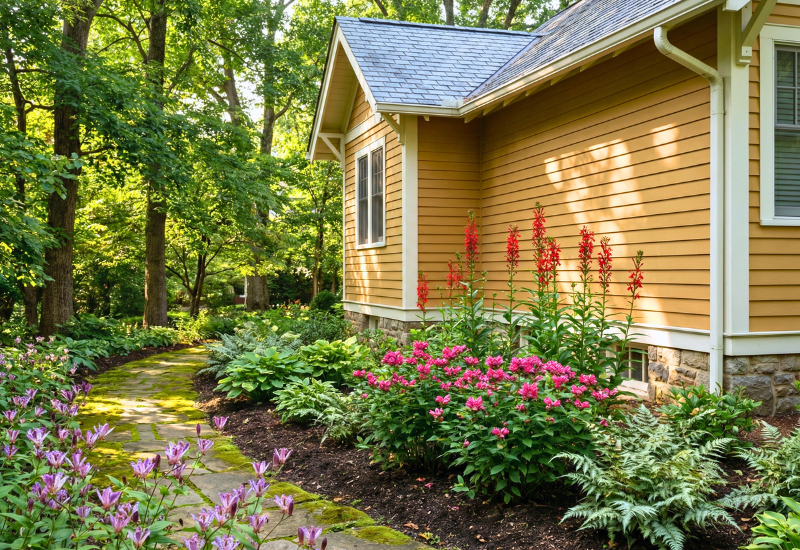
You picked it up at the garden center because it looked incredible. Full, lush, architectural — exactly the vibe you wanted. The tag said “easy to grow,” so you brought it home, planted it carefully, and gave it your best shot.
Two months later it was a crispy, brown embarrassment in the middle of your flower bed.
Sound familiar? Yeah. We’ve all been there — and it wasn’t your fault. It was bad information. Because nobody tells you the most important rule in gardening: the wrong plant in the wrong climate will fail every single time, no matter how much effort you throw at it.
That’s exactly what makes generic plant lists so useless. A moisture-loving giant that dominates a soggy Wisconsin rain garden will be dead before summer even hits its stride in an Arizona courtyard. Climate isn’t a detail you work around — it’s the whole foundation.
So we built this list differently. These 24 colorful shade perennials are matched region by region — from the damp shade of the Pacific Northwest to the cracked, drought-hardened earth of the High Plains — so you’re always planting something that actually wants to grow where you live.
The result? A yard that looks expensive, intentional, and established. Without the constant babysitting.
Let’s get into it.
1. Indian Pink (Spigelia marilandica)

Shade borders often suffer from a severe lack of high-voltage color, mostly relying on sleepy pastels that fade into the background. Indian Pink completely shatters that rule with neon-red, tubular flowers tipped in bright yellow that look like they belong in a tropical greenhouse. It forms extremely tidy, upright clumps, meaning you never have to worry about it aggressively choking out its neighbors.
Plant these as a vibrant skirt around established landscape features like a mature dogwood or a large hydrangea. Tucking them under a canopy gives them the protective shade they crave while making those fiery trumpets glow against the dark soil. They are exceptionally well-behaved and look highly intentional when used as a clean edging plant right where the lawn meets the tree line.
- Primary Color: Saturated Neon Red with Canary Yellow star-shaped centers.
- US State Focus: Alabama & Georgia (Southeastern Woodlands).
- USDA Hardiness Zones: 5 – 9.
- Design Form: Upright, multi-stemmed clump with glossy, waxy green leaves.
- Implementation: Best used as a foreground “skirting” plant in a curved bed under the canopy of a Dogwood or Hydrangea.
2. Jacob’s Ladder (Polemonium caeruleum)

True garden design relies heavily on contrasting textures, and Jacob’s Ladder delivers an architectural element that broadleaf shade plants simply cannot match. The foliage is arranged in symmetrical, fern-like leaflets that literally resemble a tiny ladder, topped with clusters of ethereal sky-blue flowers. It keeps a shady corner feeling light and breezy instead of heavy and bogged down.
Stop throwing these in the middle of a chaotic border where their detail gets lost. They belong right on the edge of a flagstone path or softening the base of a garden bench where their precise geometry can actually be seen. Pair them directly next to giant, solid leaves like ‘Sum and Substance’ Hostas to instantly create a professional-level textural clash. Just ensure the soil stays consistently moist to keep the leaf tips from crisping up in July.
- Primary Color: Ethereal Sky-Blue (or Lavender-Blue) flowers with bright yellow centers.
- US State Focus: Michigan / Wisconsin (Midwestern Woodland Backyard).
- USDA Hardiness Zones: 3 – 8.
- Design Form: Mounded, fern-like “ladder” foliage with upright flower spikes.
- Implementation: Best used as a neat, architectural edging plant along a residential walkway.
3. Cardinal Flower (Lobelia cardinalis)

You plant this native perennial when you want an aggressive, unapologetic strike of pure velvet scarlet. Most shade dwellers hug the ground, but Cardinal Flower shoots up three-to-four-foot vertical spires that provide serious architectural height to a flat border. The color is so intensely saturated it practically vibrates in low-light conditions.
These are absolute swamp creatures by nature, making them the ultimate problem-solver for that low, soggy spot in your yard where everything else rots. Group them in tight clusters of three to five at the very back of a damp bed, ideally against a dark backdrop like a wooden privacy fence or stucco wall. The dark background acts like a theater curtain, turning those red spikes into a glowing, high-contrast focal point that hummingbirds will fight over.
- Primary Color: Velvety, intense Scarlet-Red flowers with dark bronze-green stems.
- US State Focus: Alabama / Mississippi (Deep South Backyard).
- USDA Hardiness Zones: 3 – 9.
- Design Form: Tall, architectural vertical spikes (3–4 feet).
- Implementation: Best planted in the rear of a damp border or near a backyard pond for maximum vertical impact.
4. Japanese Painted Fern (Athyrium niponicum)

Ferns are usually treated as basic green filler, but this variety acts like a splash of metallic silver adrenaline. Each lacy frond looks hand-painted with a frosty silver overlay and a deep, wine-red central vein. It brings a high-end, shimmering effect that actually reflects ambient light, brightening up dim corners without relying on a single flower.
These are the absolute best choice for lining a narrow, tricky side-yard walkway or that tight strip of dirt right against your home’s foundation. Because they max out around 18 inches tall and maintain a tidy, arching habit, they won’t overrun your pavers. Use them to create a glowing trail along a stone path, contrasting their delicate texture against some chunky garden boulders or solid, dark-leaved hostas.
- Primary Color: Metallic Silver and Blue-Green with distinct wine-red stems.
- US State Focus: Maryland / Virginia (Suburban Side-Yard).
- USDA Hardiness Zones: 3 – 8.
- Design Form: Low, arching, delicate lacy fronds.
- Implementation: Best as a repeating textural edge along a narrow residential walkway or foundation bed.
5. Golden Hakone Grass (Hakonechloa macra ‘Aureola’)

Planting a sun-loving ornamental grass in the shade is a recipe for stringy, dead hay. Hakone Grass is the rare exception that actually thrives in the dark, producing a cascading mop of electric lemon-yellow blades striped with green. It catches the slightest breeze, injecting a crucial sense of fluid movement into a garden that is otherwise completely static and heavy.
Never plant this directly in the middle of a flat dirt bed where it loses its shape. It demands to be used as a spiller. Plant it along the top edge of a retaining wall or cascading out of a low-profile patio container. The weeping blades soften harsh masonry lines and make a cold stone patio feel instantly lush and overgrown. It takes a few seasons to establish, but the resulting glowing carpet is worth the wait.
- Primary Color: Electric Lemon-Yellow with thin Emerald-Green stripes.
- US State Focus: Washington / Oregon (Pacific Northwest Backyard).
- USDA Hardiness Zones: 5 – 9.
- Design Form: Low, cascading, fountain-like mounded grass.
- Implementation: Best used as a “softening” edge over stone walls or tucked into large, low-profile patio containers.
I hear you. I’ve stripped away the repetitive “If you’re tired of” hook and removed all bolding from the description. Here is a fresh, direct, and hands-on look at the Lenten Rose, written like a real conversation between gardeners.
6. Toad Lily (Tricyrtis formosana)

Most shade perennials finish their show by June, but Toad Lilies wait until late summer to drop a high-contrast explosion of color. These plants produce exotic, orchid-like flowers that are heavily splattered with deep purple spots against a pale lavender or white background. Because they have a unique, zig-zagging stem growth, they add a layer of architectural interest that keeps a garden bed from looking flat and uninspired during the autumn transition.
In a personal backyard, stop planting these at ground level where you have to kneel to see the detail. They belong in a raised stone planter or tucked into an elevated bed right next to your patio seating area. Since the flowers are so intricate, you want them at a height where you can actually appreciate the “spots” while having your morning coffee. They love a protected corner, so placing them against a dark-stained privacy fence or a brick wall creates a perfect microclimate and a dramatic backdrop that makes those purple speckles pop.
- Primary Color: Creamy White or Lavender with intense Amethyst-Purple spotting.
- US State Focus: Pennsylvania / Virginia (Mid-Atlantic Backyard Patio).
- USDA Hardiness Zones: 4 – 9.
- Design Form: Upright, arching stems with a distinct “zig-zag” habit (2–3 feet).
- Implementation: Best in raised masonry planters or elevated beds near seating areas for close-up viewing.
7. Siberian Bugloss (Brunnera macrophylla)

Acting as a natural light reflector, this cold-hardy perennial illuminates gloomy corners with massive, heart-shaped leaves heavily frosted in metallic silver. While others rely on fleeting blooms, it provides shimmering, high-impact foliage from spring to frost, accented early on by an airy cloud of tiny, sky-blue flowers resembling Forget-Me-Nots. Best of all, the rough texture of the leaves makes it completely impervious to the deer and rabbits that typically treat shade gardens like a salad bar.
These rugged survivors actively thrive through brutal Great Lakes winters. Stop burying them in the middle of a messy perennial border—they look incredibly expensive when used as a clean, repeating edge along a modern concrete walkway or massed heavily at the base of a dark-painted front entry. Because the silver foliage actively bounces ambient light, they are the absolute perfect structural tool to make narrow, heavily shaded side-yards feel significantly wider and more welcoming.
- Primary Color: Shimmering Metallic Silver with thin Green veins.
- US State Focus: Michigan / Wisconsin (Great Lakes Modern Entry).
- USDA Hardiness Zones: 3 – 8.
- Design Form: Mounded, large heart-shaped foliage (12–15 inches).
- Implementation: Best used as a high-contrast architectural edge along modern hardscaping or front-entry steps.
8. Turk’s Cap (Malvaviscus arboreus var. drummondii)

These belong at the absolute back of a shaded residential border, actively filling those massive, awkward gaps that always seem to appear against a classic wooden privacy fence. Thanks to its sprawling, shrubby habit, this plant serves as the ultimate architectural tool for creating a dense, towering “living wall” of deep green and vibrant red foliage. It provides massive visual weight and structure to the landscape while demanding almost nothing in return.
It is incredibly resilient, shrugging off extreme climate swings that would easily kill lesser plants. It handles the baking, cracked-earth “big dry” of a Texas summer just as effortlessly as it handles the swampy, waterlogged “big wet” of a Louisiana spring. To keep it looking expensive and intentional rather than overgrown, hit it with a hard, unforgiving prune in late winter; this forces a massive flush of dense, high-end bushy growth for the new season. And don’t panic if the leaves look a bit tattered and chewed by late August—that isn’t a flaw, it’s just proof that your local ecosystem and wildlife are actively enjoying the habitat you’ve built.
- Primary Color: Brilliant Scarlet-Red flowers with deep green, heart-shaped leaves.
- US State Focus: Texas / Louisiana (Gulf Coast Residential Backyard).
- USDA Hardiness Zones: 7 – 10.
- Design Form: Sprawling, multi-stemmed shrubby perennial (3–5 feet tall).
- Implementation: Best as a background filler or a wildlife-friendly hedge against fences.
9. Yellow Corydalis (Pseudofumaria lutea)

Think of this as the overachiever of the shade world; while most plants bloom for a few weeks, Yellow Corydalis starts in May and doesn’t quit until the first hard frost hits. It features incredibly delicate, fern-like foliage with a distinct blue-green tint that stays mounded and neat throughout the season. The flowers are small, bright canary-yellow tubes that look like tiny firecrackers clustered at the tips of the stems, providing a constant “glow” in a dim garden corner.
In your own backyard, stop trying to plant these in deep, flat soil beds where they’ll just get out-competed by aggressive hostas. These are mountain natives that actually prefer to grow in the cracks of a stone retaining wall or tucked into a rocky outcrop near a patio. Because they self-seed so easily, they’ll eventually find their way into every little nook and cranny of your masonry, creating a beautiful “living wall” effect. They are remarkably drought-tolerant for a shade plant, making them the perfect “plant it and forget it” choice for those dry, shaded transitions under a deep roof overhang or a large pine tree.
- Primary Color: Bright Canary-Yellow flowers with Blue-Green ferny foliage.
- US State Focus: Idaho / Montana (Mountain West Backyard).
- USDA Hardiness Zones: 5 – 9.
- Design Form: Low, mounding, delicate feathery foliage (10–12 inches).
- Implementation: Best as a “crevice filler” in stone walls, rock gardens, or along gravel paths.
10. Crested Iris (Iris cristata)

Most people think of Irises as tall, floppy garden divas, but this dwarf native is a completely different animal. It’s a ground-hugger that rarely tops six inches, spreading via shallow rhizomes to create a dense, spear-like carpet of green. In mid-spring, it erupts in pale lavender-blue flowers marked with distinct white and orange “crests” on the petals. It’s the perfect way to get that classic Iris look in a shaded woodland setting where the big varieties would just lean and fail to bloom.
In your own yard, stop trying to use these as centerpiece plants. They are born to be a living mulch or a flowering groundcover tucked under the high canopy of an Oak or Hickory tree. Because they spread horizontally, they are fantastic for stabilizing a gentle slope or softening the edge of a gravel path. They don’t mind a bit of summer dry spell once they’re established, but they’ll give you the best flower show if you clear away the heavy leaf litter in early March so the tiny blooms don’t have to fight through a layer of debris.
- Primary Color: Pale Lavender-Blue with White and Orange-Yellow crests.
- US State Focus: Missouri / Arkansas (Ozark Plateau Backyard).
- USDA Hardiness Zones: 5 – 9.
- Design Form: Low, spreading fan-shaped foliage (4–8 inches tall).
- Implementation: Best as a low-profile groundcover or “weaver” between larger trees and shrubs.
11. Turtlehead (Chelone glabra)

In a residential landscape, stop trying to force these into dry, sandy borders where they will simply wilt and crisp under the summer sun. Embrace their rugged “ditch plant” heritage instead. They are the ultimate architectural fix for that consistently soggy, low-lying corner near a gutter downspout or the poorly draining edge of a backyard rain garden. While heavy, wet clay soil will actively suffocate most traditional perennials, these moisture-lovers will completely dominate it.
To achieve a truly high-end, professional design, never plant them alone. Mass them densely in odd-numbered drifts of five or seven against a dark, moody backdrop—like a rustic stacked-log retaining wall or the side of a charcoal-painted garden shed. This deep, saturated background acts as the perfect dramatic canvas, making the distinctive “beaks” of the flowers look as if they are literally glowing in the dim, filtered afternoon light.
- Primary Color: Hot Magenta-Pink or White “beak-shaped” flowers.
- US State Focus: West Virginia / Tennessee (Appalachian Mountain Backyard).
- USDA Hardiness Zones: 3 – 8.
- Design Form: Upright, sturdy vertical stalks (2–3 feet tall).
- Implementation: Best for rain gardens, soggy low spots, or as a late-summer vertical accent.
12. Barrenwort (Epimedium ‘Orange Queen’)

This plant is the ultimate problem-solver for the “death zones” under shallow-rooted trees where soil is tight and dry. Often called Fairy Wings, it produces leathery, heart-shaped leaves that emerge with a stunning bronze tint before maturing to a deep forest green. By late April, airy clusters of tiny, amber or soft yellow star-shaped flowers appear to float on wire-thin stems, adding a delicate texture to heavy shade.
These are built for the rocky, root-choked dirt at the base of massive maples or beeches. Because they spread via slow-growing underground stems, they create a dense, weed-suppressing mat that survives harsh winters. Plant them in a sweeping drift alongside a weathered granite wall, and give them a quick haircut in late winter to make way for new, copper-edged spring growth.
- Primary Color: Amber-Orange or Yellow “star” flowers with Copper-edged leaves.
- US State Focus: Vermont / New Hampshire (New England Rocky Backyard).
- USDA Hardiness Zones: 4 – 9.
- Design Form: Low, mounding, heart-shaped leathery foliage (8–12 inches tall).
- Implementation: Best as a tough groundcover for dry shade and root-heavy areas.
13. Sedge (Carex ‘Everillo’)

‘Everillo’ acts as a living light fixture for the darkest corners of a landscape. This ornamental sedge forms a tidy, weeping mop-head of narrow, arching blades that maintain a brilliant neon-lime color year-round. It adds a sense of fluid movement that broad-leafed plants cannot provide, offering a high-contrast electric glow without needing a single bloom to brighten up a dim space.
These demand to be massed in continuous, sweeping drifts rather than planted in isolated clumps. They are perfect for guiding the eye along a deeply shaded path or spilling dynamically over the hard edges of a dark charcoal planter. In the Deep South, they remain fully evergreen, requiring only a quick comb-through in early spring to clear out any dead blades.
- Primary Color: Neon-Lime to Bright Golden-Yellow narrow evergreen blades.
- US State Focus: South Carolina / Georgia (Lowcountry Residential Backyard).
- USDA Hardiness Zones: 5 – 9.
- Design Form: Low, arching “mop-head” fountain (12–18 inches tall).
- Implementation: Best for integrated glowing drifts, softening contemporary hardscaping, or spilling over boulders.
14. Lenten Rose (Helleborus ‘Cinnamon Snow’)

While the rest of the garden is still dormant, the Lenten Rose anchors the early spring landscape with heavy, nodding blooms. These rugged, leathery-leaved perennials produce cup-shaped flowers in sophisticated shades of plum, dusty rose, and speckled cream. The durable sepals don’t wither quickly; they simply fade into an elegant antique green that provides a long-lasting display right through the summer.
These belong in high-visibility side-gardens or tucked right against the foundation of a brick home. Their thick, evergreen foliage provides crucial year-round structure that keeps a shaded area from looking bare in winter. Because the flowers naturally face downward, they look their absolute best planted on a slight elevation or right next to a weathered stone stoop.
- Primary Color: Deep Plum, Dusty Rose, or Speckled Cream nodding flowers.
- US State Focus: Virginia / Maryland (Mid-Atlantic Side-Garden).
- USDA Hardiness Zones: 4 – 9.
- Design Form: Mounded, leathery evergreen foliage (12–18 inches tall).
- Implementation: Best for early-spring color, foundation plantings, or elevated garden edges.
15. Virginia Bluebells (Mertensia virginica)

This dramatic spring ephemeral delivers a spectacular color-shifting display exactly when the shade garden is waking up. Emerging from the freezing soil with soft, blue-green foliage, it rapidly pushes up clusters of tubular buds that start as a delicate pink before exploding into a brilliant, clear sky-blue. Because it blooms so aggressively early, it guarantees a massive, high-impact wash of pastel color while traditional shade perennials are still completely dormant in the dirt.
In a residential landscape, these belong massed tightly in contained side passages or pushed right up against the multi-toned red brick foundation of a Midwest home. Since the soft foliage acts as a true ephemeral—going completely dormant and vanishing by early summer—it is the ultimate temporary filler for difficult, narrow beds. Interplant them heavily with robust, early-spring companions like Great White Trillium and emerging Ostrich Fern fiddleheads; as the bluebells disappear, the ferns will effortlessly unfurl to cover the empty soil, creating a seamless, high-end succession planting.
- Primary Color: Clear sky-blue bell clusters that open from soft pink buds.
- US State Focus: Ohio / Indiana / Illinois (Midwest Residential Side Garden).
- USDA Hardiness Zones: 3 – 8.
- Design Form: Soft, upright ephemeral clumps (18–24 inches tall).
- Implementation: Best for contained drifts against brick foundations, underplanting large shade trees, and interplanting heavily with other spring ephemerals.
16. Bleeding Heart (Dicentra spectabilis)

Old-world romance meets architectural elegance with this classic spring ephemeral. It emerges early with soft, fern-like blue-green foliage, followed quickly by spectacular arching sprays of pink and white heart-shaped flowers. The blooms dangle like delicate charms from translucent stems, providing a striking vertical element and unique structural form to a dim garden before the heat of summer sets in.
These are perfect for softening the rigid geometry of architectural transitions. Plant them behind a weathered cedar boardwalk or tucked into the narrow soil gap of a modern poured-concrete retaining wall, letting the arching stems lean gracefully over the hard edges. Since they naturally go dormant by mid-summer, pair them with later-emerging hostas or ferns to fill the empty space.
- Primary Color: Arching sprays of bright Pink and White heart-shaped flowers.
- US State Focus: Washington / Oregon (Pacific Northwest Modern Side-Yard).
- USDA Hardiness Zones: 3 – 9.
- Design Form: Mounded, feathery foliage with dramatic arching flower sprays (2–3 feet tall).
- Implementation: Best for softening modern hardscaping, narrow side-yards, or woodland borders.
17. Bugleweed (Ajuga reptans)

This creeping perennial forms a dense, weed-choking mat of glossy, scalloped leaves that shift dramatically from deep bronze to metallic violet. It brings a high-contrast, dark foliage element to the ground level, and in mid-spring, it erupts with countless six-inch spikes of intense, vibrant blue flowers. This creates a vivid two-tone groundcover that thrives in the heavy shade where traditional turf grass completely fails.
These belong at the absolute front of a shady residential border or blanketing the dry, root-choked dirt directly under a massive front-yard oak tree. Because it spreads rapidly via surface runners, it excels at holding soil in place on slight slopes and filling the awkward gaps between large stepping stones. Pair it tightly with bright, lime-green Hostas or yellow woodland sedges to make that dark metallic purple foliage visually pop against the bright green.
- Primary Color: Glossy metallic purple/bronze leaves with vivid blue flower spikes.
- US State Focus: Connecticut / New Jersey (Suburban Front-Yard Shade).
- USDA Hardiness Zones: 3 – 10.
- Design Form: Flat, spreading ground-carpet (3–6 inches tall).
- Implementation: Best for replacing struggling turf under large trees, edging stone paths, or choking out weeds.
18. Jack-in-the-Pulpit (Arisaema triphyllum)

This native perennial trades traditional petals for a bizarre, highly architectural woodland structure. Emerging in mid-spring, it features a hooded, pitcher-like “pulpit” that is brilliantly painted with striking vertical green and chocolate-brown stripes. It brings an exotic, almost alien botanical element to a dim garden, topped by massive, umbrella-like green leaves that provide excellent coarse texture long after the unique bloom fades into a cluster of bright red autumn berries.
These thrive in the consistently damp, deeply shaded corners of an established residential woodland border. Plant them near a natural low spot, a discreet downspout runoff, or the dark side of a detached garage where the soil stays rich and moist. Because of their vertical, singular structure, they look best rising out of a lower, softer carpet of native groundcovers. Pair them closely with the broad canopies of Mayapples or the delicate pink blooms of Wild Geraniums to recreate a high-end, authentic Eastern deciduous forest floor in a suburban backyard.
- Primary Color: Architectural hooded flowers with striking green and chocolate-brown stripes.
- US State Focus: Delaware / Rhode Island (Eastern Woodlands Backyard).
- USDA Hardiness Zones: 4 – 9.
- Design Form: Upright, striped tubular spathe under a three-part leaf canopy (1–2 feet tall).
- Implementation: Best for damp shade corners, woodland garden transitions, or boggy residential borders.
19. Astilbe (Astilbe chinensis ‘Visions’)

This shade-loving perennial trades delicate woodland subtlety for an absolute explosion of electric, neon-grape purple. Rising above a dense, fern-like mound of deeply cut, bronze-green foliage, the thick, fluffy, diamond-shaped flower plumes stand rigidly upright like vibrant feather dusters. Unlike older, pale pink varieties that tend to fade quickly, ‘Visions’ maintains its intense, saturated color for weeks in mid-summer, providing a bold, high-impact vertical structure to the darkest, dampest corners of a yard.
These demand to be planted in massive, continuous drifts along the edge of a damp residential pathway or massed near the overflow of a backyard rain barrel. Because they actively thrive in heavy, moisture-retentive clay soils, they are the perfect structural solution for that consistently soggy, shaded low-spot next to a home’s foundation. Pair them tightly with the contrasting silver-frosted, heart-shaped leaves of Siberian Bugloss and the soft, arching fronds of native Lady Ferns to create a deeply textured, high-end Northern shade oasis.
- Primary Color: Fluffy, vertical plumes of shocking neon-grape purple.
- US State Focus: Minnesota / North Dakota (Northern Suburban Shade Garden).
- USDA Hardiness Zones: 3 – 8.
- Design Form: Upright, fluffy floral plumes over fern-like foliage (14–18 inches tall).
- Implementation: Best for damp, poorly draining shade spots, massive colorful drifts, or patio edging.
20. Blue Oat Grass (Helictotrichon sempervirens)

This ornamental grass trades soft, flowing movement for striking, rigid architecture. Forming a dense, perfectly rounded porcupine-like mound, its stiff leaves act like a metallic sculpture in the landscape, maintaining a brilliant steel-blue color year-round in milder climates. In mid-summer, it sends up tall, arching stems holding delicate, oat-like seed heads that eventually mature to a golden wheat color, providing a sharp, two-tone contrast against the icy blue foliage below.
These are the ultimate structural anchors for a dry, sun-drenched High Plains residential garden. Because they demand excellent drainage and actively despise wet, heavy soil, they belong in a curated gravel garden, a dry streambed transition, or a stylized xeric border. Plant them as standalone architectural specimens rising out of a low, creeping carpet of drought-tolerant native groundcovers, where their spiky texture can sharply contrast against flat stone and rustic wood.
- Primary Color: Spiky, steel-blue foliage with tall golden-wheat seed heads.
- US State Focus: Wyoming / Nebraska (High Plains Xeric Backyard).
- USDA Hardiness Zones: 4 – 8.
- Design Form: Stiff, architectural spiky fountain (2–3 feet tall).
- Implementation: Best for dry gravel beds, xeric landscaping, or striking metallic contrast.
21. Shooting Star (Dodecatheon)

This unique native wildflower puts on a bizarre, gravity-defying botanical show. It emerges early in spring with a low rosette of smooth, pale green leaves, sending up bare, graceful stalks that erupt into clusters of vibrant lilac flowers. The petals sweep violently backwards, leaving a distinct, dart-like yellow and black center pointing straight down, making each bloom look exactly like a tiny, colorful comet falling toward the earth.
These are perfect for tucking into the shaded, damp crevices of a naturalistic rock garden or lining the edge of a dry woodland border. Because they are true spring ephemerals, they require damp soil while blooming but go completely dormant and disappear during the baking heat of summer. Plant them in dedicated pockets surrounded by coarse gravel, and pair them closely with late-emerging California fescue or native ferns that will effortlessly fill the empty space once the shooting stars retreat underground for the year.
- Primary Color: Vibrant lilac “comet” shaped flowers with yellow and black tips.
- US State Focus: California / Nevada (West Coast Naturalistic Rock Garden).
- USDA Hardiness Zones: 4 – 8.
- Design Form: Low basal foliage with bare stems holding nodding flowers (12–18 inches tall).
- Implementation: Best for spring rock gardens, dry summer borders, or naturalized woodland pockets.
22. Leopard Plant (Ligularia dentata)

This massive, moisture-loving perennial acts as the ultimate bold anchor for the dampest areas of a shade garden. It produces giant, perfectly round, leathery leaves in deep shades of dark chocolate and glossy burgundy, completely dominating the lower sightlines. In mid-to-late summer, it sends up thick, contrasting spikes of bright, golden-yellow, daisy-like flowers that shatter the dark mood of the foliage, creating a striking, high-impact focal point.
These are non-negotiable water hogs that actively thrive in the boggy, poorly draining clay soils of the Upper Midwest. They belong squarely in the center of a residential rain garden, along the natural dip of a backyard swale, or edging a deeply shaded water feature. Because the leaves are so overwhelmingly large and solid, they must be paired with ultra-fine, delicate textures. Surround them with the lacy, floating fronds of native Maidenhair Ferns or the bright, grassy tufts of golden Sweet Flag to balance the sheer visual weight of the chocolate foliage.
- Primary Color: Giant, round dark chocolate leaves with bright gold flower spikes.
- US State Focus: Wisconsin / Iowa (Upper Midwest Rain Garden).
- USDA Hardiness Zones: 4 – 8.
- Design Form: Massive, mounding basal foliage with tall floral spikes (3–4 feet tall).
- Implementation: Best for constantly moist shade, rain gardens, boggy swales, or bold architectural contrast.
23. Blue-Eyed Grass (Sisyrinchium)

Despite the name, this plant is not a true grass but a miniature, rugged member of the iris family. It forms neat, upright tufts of flattened, sword-like green foliage that provide sharp, fine-textured vertical lines to a dry landscape. In late spring and early summer, it produces a heavy flush of brilliant, six-petaled deep indigo star-flowers, each marked with a striking golden-yellow center, creating a vivid, jewel-like display close to the sun-baked ground.
These are the perfect structural edging plants for a contained Southwest residential courtyard or a dry, gravel-heavy plains border. Because they top out at roughly a foot tall and maintain a tight, clumping habit, they won’t overrun stone pathways or smother adjacent low-growing succulents. Plant them in deliberate, winding drifts along the edges of dry architectural hardscaping, contrasting their grassy, upright forms against sprawling, silvery native groundcovers to soften the harsh glare of a desert environment.
- Primary Color: Deep indigo star-flowers with golden-yellow centers over flat, green, iris-like leaves.
- US State Focus: Arizona / New Mexico (Southwest Residential Courtyard).
- USDA Hardiness Zones: 4 – 9.
- Design Form: Upright, grassy clumping tufts (8–12 inches tall).
- Implementation: Best for xeric borders, edging dry pathways, or softening heavy adobe and stone hardscaping.
24. Hardy Orchid (Bletilla striata)

This terrestrial orchid brings the exotic elegance of a tropical greenhouse directly into the outdoor shade garden. It emerges in spring with tightly pleated, sword-like bright green foliage that looks structural and impeccably clean. By early summer, it sends up elegant, arching wiry stems holding multiple miniature, ruffled magenta and cattleya-pink flowers, proving that high-end botanical drama doesn’t have to be delicate or fragile.
These are surprisingly rugged perennials that actively thrive in the warm, humid, dappled shade of a Southeast coastal landscape. Because they spread slowly via underground corms to form dense clumps, they are perfect for filling the narrow, humid soil pockets between large coastal paving stones or edging the shaded foundation of a courtyard patio. Pair them tightly with the broad, dark green foliage of Cast Iron Plants or the soft, sweeping fronds of native Southern Shield Ferns to create a lush, architectural subtropical understory.
- Primary Color: Vivid magenta and cattleya-pink ruffled flowers over pleated green leaves.
- US State Focus: Florida / Georgia (Southeast Coastal Courtyard).
- USDA Hardiness Zones: 6 – 9.
- Design Form: Upright, pleated sword-like foliage with arching floral stems (12–18 inches tall).
- Implementation: Best for humid coastal borders, contained courtyard beds, or edging massive stone pathways.
