

Lilac jelly is one of my favorite ways to bottle up spring before it disappears. This low sugar version uses Pomona’s Universal Pectin and just one cup of sugar, which lets the actual lilac flavor come through instead of getting buried under sweetness. It’s a safe water bath canning recipe, and it’s one of the easiest flower jellies you’ll ever make.

There’s a lilac bush at the corner of my yard that I’m fairly certain has been there longer than I have. It’s enormous — the kind that arches over the fence and drops petals onto the sidewalk like confetti every May. When I was a kid, my grandmother had one just like it outside her kitchen window, and every spring the whole house would smell like someone had uncorked a bottle of something impossibly good. I didn’t know you could eat lilacs back then. I just thought they were for burying your face in and breathing until your lungs gave out.
Turns out, they’re so much more than that.
This low sugar lilac jelly is one of those recipes that stops people mid-bite. Nobody expects lilacs on their toast. And the flavor — oh, the flavor. It’s soft and floral with a sweetness that reminds me of warm honey stirred into chamomile tea on a slow afternoon. It’s the kind of thing you open in January when the world is grey and frozen, and for a second — just a second — you’re standing barefoot in your backyard in May.
I’ve been making flower jellies for a few years now, ever since I realized that the edible blooms growing all around the homestead were more than just something pretty to admire from the kitchen window. Violets, dandelions, forsythia — they’ve all had their turn. But lilac jelly holds a special place for me. Maybe it’s because the scent of lilacs is so tied to this particular season, when the soil is finally warming and the garden is coming alive again after months of grey. There’s something deeply satisfying about spooning that fragrance onto a warm biscuit in the middle of January, when the snow is piled up outside and spring feels like a distant promise.
Let’s make some.
But Wait — Lilacs Are Edible?
I know. I had the same reaction the first time someone told me. I stared at them like they’d suggested I eat my curtains. But yes, lilac blossoms (Syringa vulgaris) are completely edible, and people have been using them in cooking and herbal preparations for centuries. They’ve also been traditionally valued for their soothing and anti-inflammatory properties.
All colors of lilacs work — deep purple, pale lavender, pink, white, all of them. The darker varieties give you the richest color in your finished jelly (and the most dramatic Instagram moment when you add the lemon juice and the whole pot shifts from blue to pink like some kind of kitchen witchcraft). If you’re working with white or very pale lilacs, your tea might turn out a sort of golden-khaki color. Still tastes gorgeous, but we can fix the color situation. More on that in a minute.
Harvesting: The Art of Picking Flowers Before Your Neighbors Think You’ve Lost It
Timing matters here. You want to catch your lilacs when they’re freshly opened — about half to three-quarters of the cluster in bloom, some buds still tight, others fully unfurled. This is peak fragrance, peak flavor, peak everything. Go out mid-morning after the dew has dried but before the afternoon heat shows up and wilts everything.

Bring good scissors. Lilac stems are surprisingly stubborn (I may have snapped a pair of kitchen shears on my first attempt, which I will never publicly admit to again after this paragraph).
A few things worth mentioning:
Only pick from bushes that haven’t been sprayed with pesticides or chemicals. If you’re not 100% sure, don’t risk it. Your own yard is the safest bet. You only need about 4 cups of petals for a batch, which is roughly 5 or 6 large flower clusters. Most lilac bushes produce so many blooms that this barely registers as a trim.

And here’s the part nobody warns you about: de-stemming. Once you bring your clusters inside, you need to pluck all the tiny individual blossoms away from the green stems, sepals, and leaves. The green bits taste bitter and can give your jelly an off flavor. Is this tedious? A little. But put on a podcast, sit in the sun with a bowl in your lap, and it becomes oddly relaxing. My kids actually fight over who gets to help with this part. (They lose interest approximately four minutes in, every time, but the enthusiasm is heartwarming.)
Give your petals a gentle rinse in a colander to evict any tiny stowaways, and you’re ready.
Why I’ll Never Go Back to Full Sugar Jelly
Here’s the thing about traditional flower jelly recipes — most of them call for a 1:1 ratio of sugar to liquid. Four cups of tea, four cups of sugar. That is a mountain of sweetness, and with something as quiet as lilac, all that sugar buries the floral flavor completely. You end up with a jelly that’s sweet and pretty but mostly tastes like… sugar.

Low sugar pectin changed everything for me.
Pectins like Sure-Jell Low Sugar (the pink box) or Pomona’s Universal Pectin are formulated to gel with way less sugar — sometimes as little as a cup and a half. With the low sugar version, you can actually taste the lilac. It’s lighter on the palate. It spreads on warm bread like a whisper instead of a shout. My husband, who is not generally a jelly person (his words, not mine), will stand at the counter with a spoon eating this straight from the jar when he thinks no one is watching.
Fair warning: your yield will be slightly smaller with low sugar (3 to 4 half-pints instead of 5) and the set may be a touch softer. I personally love the softer set. If you need your jelly to stand at attention on a cracker at a fancy dinner party, you might want to go closer to 2 cups of sugar. If you’re like me and prefer things a little more relaxed, 1½ cups is the sweet spot.
What You’ll Need

- 4 cups lilac blossom petals — de-stemmed, green bits removed (about 5–6 large clusters)
- 4 cups water
- 2 tablespoons lemon juice — bottled if you’re canning (for consistent pH), fresh-squeezed if it’s fridge jelly
- 1½ to 2 cups granulated sugar — adjust to your taste
- 1 box (1.75 oz) Sure-Jell Low Sugar pectin — the pink box
- A small handful of frozen blueberries (optional) — for color, especially if you’re using pale or white lilacs. They add enough natural pigment to make the jelly glow without changing the flavor one bit.
Let’s Talk Lemon Juice for a Second
I know it seems weird to add citrus to a flower jelly. I thought the same thing. Won’t it overpower the lilac? It doesn’t. It does the opposite — it brightens and lifts the floral flavor in a way that makes everything more lilac, not less. It also helps the pectin set and ensures safe acidity for canning. Don’t skip it.
And here’s the magic part: when you add lemon juice to your lilac tea, the color changes. Right before your eyes. It shifts from this murky blue-turquoise to a beautiful pink or rosy purple. The first time it happened, I actually gasped out loud. My daughter now calls this “the fairy potion step” and honestly? I’m not going to argue with that.
Let’s Make It
Step 1: Make the Lilac Tea (Day Before)
The day before you plan to make jelly, stuff your lilac florets into a clean quart-sized mason jar. Don’t pack them down tight — you want space for the water to move around and pull out the color and flavor.

If you’re using blueberries for color, drop those in now too.
Bring four cups of water to a boil. Let it cool for about five minutes — you want hot water, not a rolling boil that’ll scald the petals and muddy the tea. Pour the water over the blossoms.
Add the lemon juice right away, while the tea is still hot. This does two things. First, the acid pulls color from the petals. You’ll watch the liquid shift from blue-green to a soft pink or lavender within seconds — the kids love this part, it’s like a little science experiment at the kitchen table. Second, the acidity is necessary for safe canning. Don’t skip it.

Cover the jar and let it sit on the counter for about an hour. Then move it to the refrigerator. Let it steep overnight, or at least eight hours. The longer the steep, the more flavor you get.
Step 2: Strain It

The next day, strain the liquid through cheesecloth. I squeeze the bundle hard—harder than you’d think polite—to get every drop. You should have roughly 3½ to 4 cups of liquid the color of pale rosé or apple blush. If you’re short, add a splash of water. If you have extra, drink it cold over ice—it’s essentially lilac lemonade.
The color will fade slightly when heated. This is normal. The final jelly ranges from champagne pink to pale amber depending on your lilac variety (dark purple flowers give deeper color than white ones) and your sugar amount (more sugar = lighter color).
Step 3: The Cooking (This Goes Fast)

Pour the strained lilac tea into a large saucepan or jam pot. Add the lemon juice and watch the color change. Smile. Maybe gasp a little. It’s okay.

Pre-measure your sugar into a bowl and set it aside. You’re going to need to add it quickly once the time comes, and fumbling with a measuring cup over a pot of boiling liquid is nobody’s idea of fun. (Ask me how I know.)
Turn the heat to medium-high. Bring the tea and lemon mixture to a boil.
Once it’s boiling, slowly sprinkle in the powdered pectin while whisking or stirring like your life depends on it. Lumps are the enemy here. Keep stirring.
Bring everything back to a full rolling boil — the kind you can’t stir down — and let it boil for one full minute.

Now add the sugar all at once, still stirring constantly. Dissolve it completely, bring it back to a rolling boil, and boil for 1 to 2 minutes more.
One very important thing: always add the pectin first and dissolve it before the sugar goes in. The pectin needs to hydrate in the liquid before sugar competes for that same water. If you reverse the order, your jelly may refuse to set, and you’ll have a beautiful lilac syrup instead of jelly. (Which is honestly also delicious, but that’s beside the point.)
Pull the pot off the heat. If there’s foam on the surface, skim it off with a spoon.
Step 4: Into the Jars

Ladle the hot jelly into your prepared jars, leaving ¼ inch of headspace at the top. A canning funnel makes this approximately 400% less messy. I learned this the hard way, which is to say I learned it while sticky lilac jelly was dripping down the outside of five jars simultaneously.
Wipe the rims with a clean, damp cloth. Place the two-part canning lids on — lids first, then rings, tightened to fingertip-tight.
If you’re not canning, let the jars cool on the counter to room temperature and then stash them in the fridge. The jelly may take a full 24 hours to set, so resist the urge to poke it and judge. Be patient. It’ll get there.
Water Bath Canning (If You Want to Keep It Forever)
Ladle the hot jelly into prepared jars, leaving ¼-inch headspace. This is less than many canning recipes because low-sugar jellies expand less during processing. Wipe rims with a damp cloth—sugar crystals prevent sealing—apply lids fingertip-tight, and process in a boiling water bath for 10 minutes. Add 5 minutes if you live above 6,000 feet elevation.
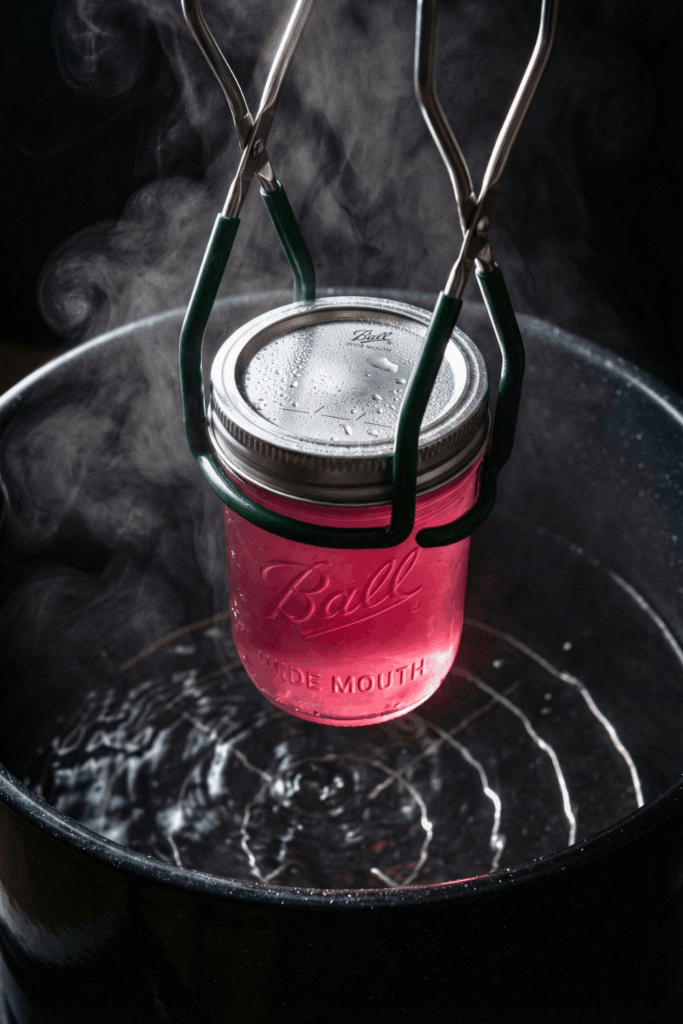
Pull the jars out and let them cool on a towel overnight. Don’t tilt them, don’t touch them. Low-sugar pectin sets slowly; the jelly might still slosh when you check it warm. Wait 24 hours. If after two days it’s still completely liquid, you can reprocess with an additional ½ teaspoon pectin, or call it “lilac syrup” and serve it over pancakes. Nobody complains about syrup.
Properly sealed jars keep for 18 months in a cool, dark cupboard. Refrigerate after opening. The low sugar content means this won’t last as long as commercial jellies once opened—use it within three weeks, or freeze it for up to six months. Frozen low-sugar jelly weeps when thawed; stir it before using.
So What Does It Actually Taste Like?
Everyone asks this, and it’s a fair question because until you’ve tried it, it’s hard to imagine eating a flower.
The best way I can describe it: it tastes like springtime in a jar. There’s a floral sweetness — like warm honey with a whisper of lavender — and a clean, bright finish from the lemon juice that keeps the whole thing from going too perfume-y.
Because we’re using less sugar, the lilac flavor is the thing you notice first, not the sweetness. It lingers on the tongue the way the smell of lilacs lingers in a room after you’ve brought a bunch inside.
Ways to Enjoy Your Lilac Jelly
Once you’ve got a few jars glowing on your shelf, here’s where to start:

Spread it on warm toast, fresh biscuits, or scones with salted butter underneath. This is the classic and it’s classic for a reason.
Pair it with cheese. Soft, creamy cheeses like brie, chèvre, or camembert are stunning next to lilac jelly. Put it on a cheese board and watch people’s eyes go wide when you tell them what it is.
Use it in baking. It makes a gorgeous filling for thumbprint cookies, layer cakes, or cupcakes. Between cake layers with cream cheese frosting? Stop.
Swirl it into yogurt or drizzle over oatmeal for a morning that feels a little more special than the usual Tuesday.
Stir a spoonful into sparkling water, lemonade, or champagne. Yes, champagne. You deserve it.
Melt it gently and brush over roasted chicken, pork, or grilled salmon for a glaze that will make everyone at the table ask what your secret is.
When Things Go Wrong (And They Will, Sometimes)
The jelly didn’t set. Either you undercooked it, overcooked it, or your pectin was expired. Lilac jelly is forgiving—you can reprocess it within 24 hours. Pour it back into the pot, bring to a boil, whisk in another teaspoon of pectin mixed with sugar, and re-can.
It’s cloudy. You probably squeezed the cheesecloth too hard and forced starch from the flower bases into the liquid. It’s still edible; it just looks like apple cider instead of wine.
It’s brown instead of pink. You forgot the lemon juice, or your water was heavily chlorinated. Use distilled water next time, and don’t skip the acid.
It tastes like grass. You left stems in the steep, or used flowers that were past peak. Wait for next year.
Storage
Canned and sealed jars: Cool, dark pantry, 12–18 months. Refrigerate after opening.
Fridge jelly (not canned): 3–4 weeks, refrigerated.
Freezer jelly: Pour into freezer-safe containers with ½ inch headspace. Good for up to 6 months. Thaw in the fridge before using.
The Recipe
Yield: 3 to 4 half-pint jars Prep: 15 minutes + 4–24 hours steeping Cook: 15 minutes Canning Time: 10 minutes (optional)
Equipment
- Large saucepan or jam pot
- Fine mesh strainer or cheesecloth
- Quart-sized mason jar (for steeping)
- Canning jars with two-part lids
- Canning funnel (trust me on this one)
- Water bath canner (if preserving)
Ingredients
- 4 cups lilac blossom petals, de-stemmed
- 4 cups water
- 2 tablespoons lemon juice (bottled for canning, fresh for fridge jelly)
- 1½ to 2 cups granulated sugar
- 1 box (1.75 oz) Sure-Jell Low Sugar powdered pectin (pink box)
- A small handful of frozen blueberries (optional, for color)
Instructions
- Place de-stemmed lilac petals (and optional blueberries) in a quart mason jar.
- Bring 4 cups water to a boil. Pour over the blossoms. Cover and steep 4 to 24 hours. Refrigerate if steeping longer than a few hours.
- Strain the tea through a fine mesh strainer or cheesecloth, pressing to extract all the liquid. You need about 3½ to 4 cups.
- Pour strained tea into a large saucepan. Add lemon juice. Watch the color change and try not to squeal.
- Pre-measure sugar and set it aside.
- Bring tea and lemon mixture to a boil. Slowly add pectin, stirring constantly to dissolve.
- Return to a full rolling boil and boil for 1 minute, stirring the entire time.
- Add sugar all at once. Stir to dissolve.
- Bring back to a rolling boil. Boil 1–2 minutes, stirring constantly.
- Remove from heat. Skim foam.
- Ladle into prepared jars, leaving ¼ inch headspace. Wipe rims. Cap with two-part lids.
- For canning: Process in water bath canner for 10 minutes (15 minutes above 6,000 ft). Cool undisturbed 24 hours. Check seals.
- For fridge jelly: Cool to room temperature, then refrigerate. Allow 24 hours for full set.
Recipe Notes
Pectin: Written for Sure-Jell Low Sugar (pink box). For Pomona’s Universal Pectin, follow the directions in their box using the mint jelly recipe as a guide.
Color: Dark purple lilacs give the most vivid jelly. For pale or white varieties, a few frozen blueberries during steeping adds beautiful color without changing the flavor.
Lemon juice: Don’t skip it. Brightens flavor, activates pectin, ensures safe acidity for canning.
Sugar flexibility: With low sugar pectin, you can go as low as 1½ cups or up to 3. Less sugar means more lilac flavor, a slightly softer set, and slightly lower yield.
Steeping time: Longer is better for flavor. 24 hours gives the most intense lilac taste, but even 4 hours makes a lovely jelly.
The lilac season is short and sweet — literally. If the bushes in your neighborhood are blooming right now, this is your sign. Grab a basket, snip a few clusters, and turn them into something you’ll be grateful for when the snow comes back. Future you, standing in the kitchen in December, cracking open a jar and catching that first impossible whiff of spring — that version of you is going to be so glad you did this.
