


There is a certain day that every gardener in snowy areas despises. After a heavy and wet storm hits early in the season, the morning will come where you open the curtains, drink your coffee, and realize that your big evergreen shrub by the stairs is flopped right over, resembling a peeled banana.
Even though you try to straighten it and tell yourself that the branches will recover, they usually end up staying bent in different directions. More often than not, there will be a branch or two broken at the base, which ruins a whole decade’s worth of work raising this beautiful shrub. While we usually point our fingers at the cold weather damaging our shrubs, what really does the damage is the sheer weight of this saturated snow. This type of snow sticks to branches and twigs and causes them to collapse under its force. After that, wind, sun and hard freezes wreak havoc on shrubs untouched by the initial storm, burning leaves and destroying flower buds.
However, what truly pains me is how easily all of this can be avoided.
One hour of work can stop this from occurring this winter. All it takes is one mild afternoon, some jute string and burlap fabric, and knowledge of what shrubs are in need of protection and in what form that takes shape. Here are the seven types of shrubs I’d protect at all costs.
Why Wet Snow Does More Damage Than a Deep Freeze
Wet snow is much heavier than powder snow and damages shrubs far more seriously because of the mechanics involved with landing on the plant matter.
Powder snow will slide off branches, or be blown away by the wind, meaning that the weight doesn’t settle anywhere in particular and the tree does not need to bear the load. However, in wet snow scenarios, the snow falls and sticks wherever it lands, continuing to accumulate for however long the storm lasts.
Evergreen trees with multiple stems rather than trunks will suffer the worst damage in a snowy season because they are structurally unsound. This fact is confirmed by sources like Illinois Extension who state that snow damage affects multiple stems before collapsing completely due to no central support holding the branches upright.
Not all shrubs here require the same preventative action against wet snow damage. Some species will need to have their stems bundled up to protect from separation while other species, who rarely fall victim to structural damage but lose foliage, should be wrapped.
1. Arborvitae, the One That Splits Right Down the Middle
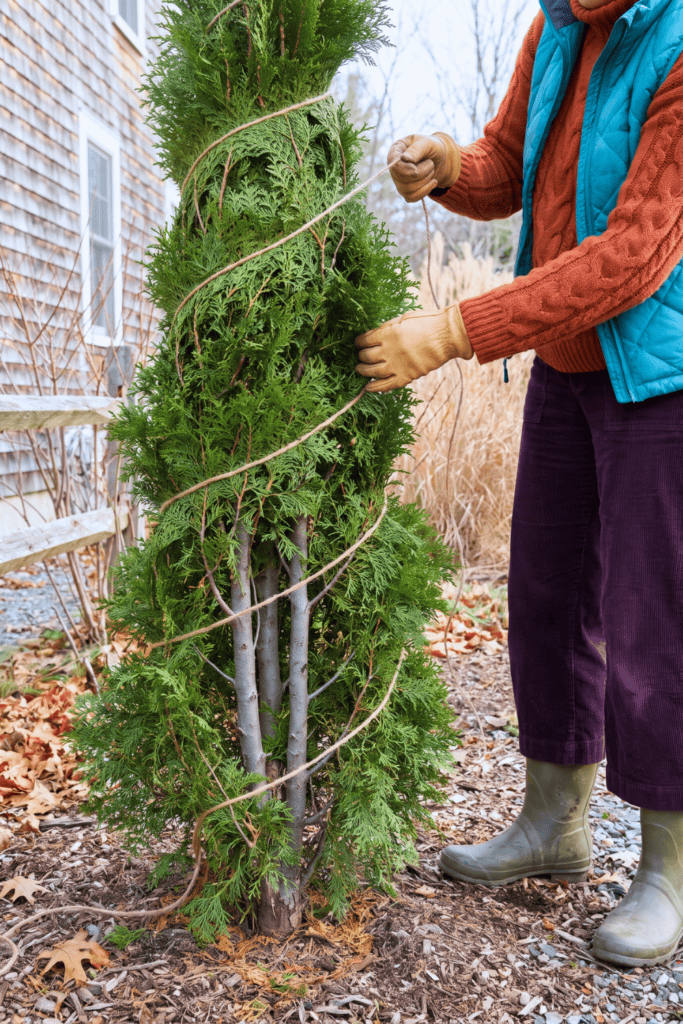
This simple preventative method for protecting your arborvitae is worth considering, especially since the alternative involves dealing with splitting trees. The arborvitae tree consists of multiple thin trunks grouped tightly together, creating a uniform appearance. However, once heavy snow falls onto the tree, these trunks separate, causing splits to form.
Fortunately, this issue has an easy fix that requires nothing more than some jute twine. Start by attaching one end of the twine to the base of the arborvitae trunk. Then wind the twine upwards in a spiral shape while gathering the branches together to form a narrower cone shape. This step requires careful work to avoid breaking any branches while securing them. Burlap isn’t necessary in this process, either. One homeowner located in Northern British Columbia explained that his method was simply tying up the arborvitaes every autumn, leaving everything else untouched. The twine is removed come spring after the last of the snow melts.
By using jute twine correctly, you can ensure the health and safety of your arborvitae all year round.
2. Yew, Tough Until the Roof Unloads on It
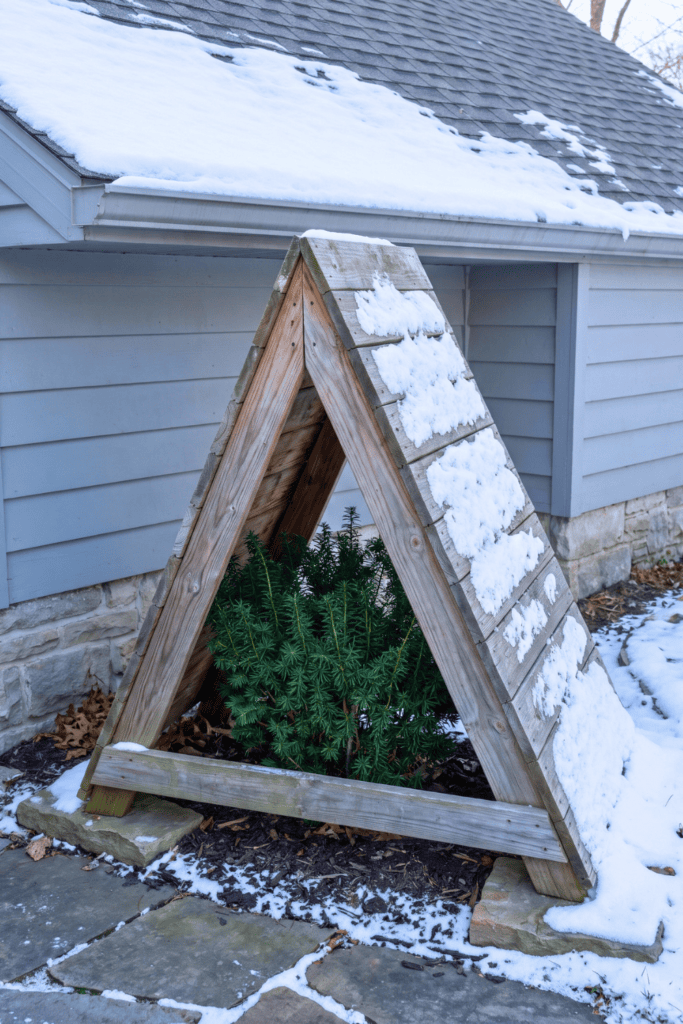
Although there aren’t many who would consider yews fragile plants, it seems this isn’t entirely true when you consider the upright cultivars. While yews can handle the shade, harsh pruning, and frigid winter temperatures, the upright varieties like Hicks yew are more fragile since they grow with a large number of vertical shoots. According to Nebraska Extension, these pyramidal yews belong alongside arborvitaes, as the shrubs need to be fastened firmly to stakes using thick jute rope prior to winter.
The placement of a yew shrub becomes critically important in terms of its safety from falling snow. Many yew shrubs find themselves growing adjacent to the building foundation, positioned directly beneath the edge of the roof. Once this mass of snow melts off the roof, it falls all at once into the shrub below. Iowa State Extension recommends that anyone who clears his or her roof and drive after snowfall must not deposit this snow onto his or her shrubs. Instead, a simple wooden frame erected over the top of the shrub takes the impact instead.
3. ‘Sky Pencil’ Holly, the Skinny One Nobody Thinks to Tie

This shrub is commonly spotted paired up alongside a doorway or patio corner in landscaping, planted symmetrically. Sky pencil refers to the variety of Japanese Holly which is grown for its tall, columnar form and reaches heights while only spreading out just two feet wide. It’s rare to think of a Japanese Holly as requiring any protection from winter conditions, however the North Carolina State University Extension classifies Sky pencils, arborvitae, and upright Junipers as evergreen trees that get flattened and deformed during winter storms of heavy snowfall.
Since Sky pencils are not conifers, but rather have slender branches, it may be advisable to be less rigorous with your technique than the methods described previously. Rather than securing branches tightly, the Illinois Extension recommends wrapping stems with strips of soft cloth or coated twine. Both will be more gentle with delicate branches. Just three or four loosely bound ties spaced evenly along the trunk will suffice. If you have grown your Sky pencil in a pot, it may additionally benefit from relocation to prevent getting caught beneath an overhanging roof edge.
4. Boxwood, Flattened From the Top and Burned From the Side
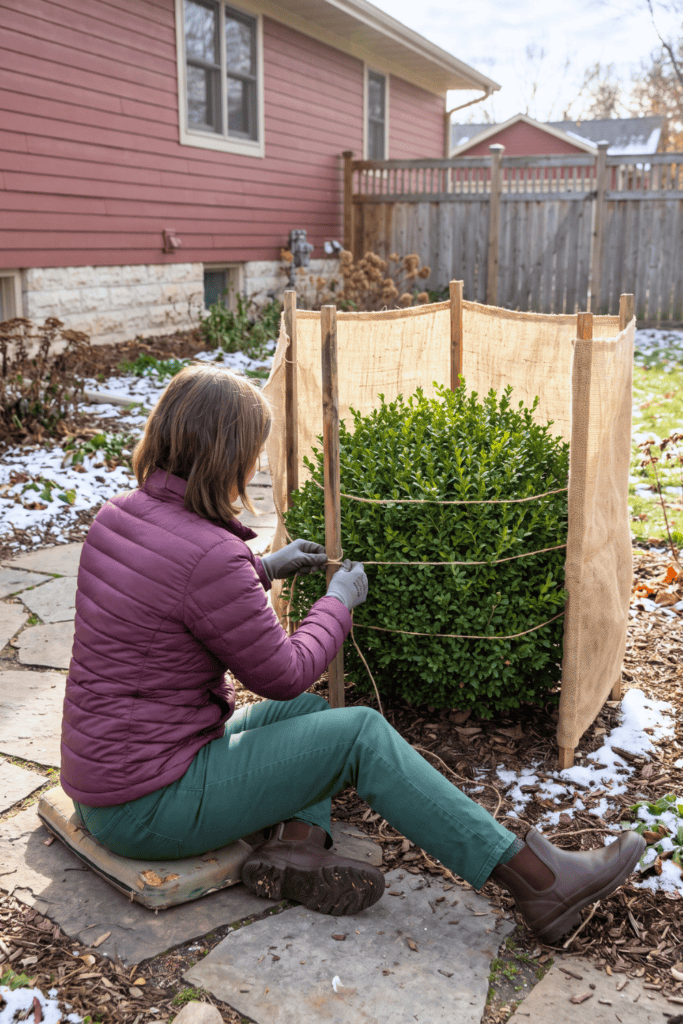
For the boxwood, this issue presents itself in an alternative form since snow does not tend to crack but rather crush this particular shrub, thanks to the numerous small flexible branches which will yield under weight. One gardening blogger notes that crushed boxwood proves very hard to restore since the sheer number of branches makes them prone to breakage under crushing pressure. To reduce their chances of flattening during the next snowstorm, wrap several rounds of twine around them prior to winter onset to bunch up the branches.
This species happens to be the only one on our list thus far requiring both wrapping and tying, due to their evergreen nature, which causes them to continue evaporating water throughout the entire winter period. The result is usually quite noticeable by March since the side which faces the sun ends up looking burnt orange or brown by then. According to one Ask Extension Q&A from the University of Minnesota, erecting burlap fencing on the south-west and windward sides will provide protection while still leaving enough ventilation on top of the structure. More importantly, it is vital to ensure adequate hydration before freezing occurs.
5. Upright Juniper, Which Rarely Gets a Second Chance

There are plenty of juniper varieties such as Skyrocket, Spartan, and Taylor, all known to remain slim and vertical with no trimming required. While it appears that this trait makes them vulnerable during heavy snowfall, they lack the tolerance for damage shown in arborvitae species. In response to a query regarding how best to fix a Spartan juniper that opened outwards due to storm damage, the answer was clear – limbs which bow away like this tend not to return to their upright positions. This means that you have one shot at protecting this tree against heavy snowfalls.
Use the exact technique used on your other columnar evergreens, applying the twine in a spiral from bottom to top. Focus especially on the upper sections of the tree, where the branches are thinner. According to the blog post ‘Winter Burn and Snow Damage’, published by The Garden Professors, securing the top third of these shrubs becomes the sole line of defense for such plants in snowy climates. Don’t tie too tightly however.
6. Rhododendron, Drying Out While the Ground Is Frozen

The rhododendron’s leaves curl into cigar shaped coils in very cold mornings before dropping. Many people conclude that this indicates death but it’s actually perfectly healthy behavior, and once warmed by the day they uncurl. Any harm is shown by their dried, crispy edges months later, and the reason isn’t that they were bearing snow loads.
The rhododendron retains its large leaves throughout winter because as Penn State Extension describes, ‘broadleaf evergreens’ release water vapor consistently through their leaves all winter. An issue raised by this behavior as explained to Bob Vila by an arborist is that while doing this, frozen soil prevents returning moisture from underneath nearly as effectively as usual.
While stringing them up isn’t going to help, the solution recommended by the expert is the erection of burlap screens supported by wooden posts, several inches away from the branches. Position them downwind from both the tree’s direction of exposure and afternoon sunlight. Prior to freezing of the earth ensure thorough hydration for your plants.
7. Bigleaf Hydrangea, With Next Summer’s Flowers Already on the Stems

Have you planted a Bigleaf Hydrangea in hopes of beautiful blue or pink mop heads only for the plant to come up green again in the spring without blooming all summer? Most often than not, winter is responsible for killing off this pretty flowering shrub. This particular Hydrangea variety is one which blooms on old wood. This means that the buds for next summers flowers are waiting patiently right now along the branches.
It doesn’t matter how many times you tie down your plant, because what it really needs is protection. At the New York Botanical Gardens, they advise that four-six stakes are planted into the earth surrounding your shrub and then burlap is secured to cover these stakes, without covering the top as wind protection provides sufficient cover. If you’re located in a colder zone than usual, then one source suggests taking this process even further. As advised by an expert in horticulture at an Illinois extension office, you can stuff this protective enclosure full of insulating material such as straw or dead leaves.
Leave it in place until after the last frost date of springtime passes and remove it carefully so as not to dislodge flower buds.
