

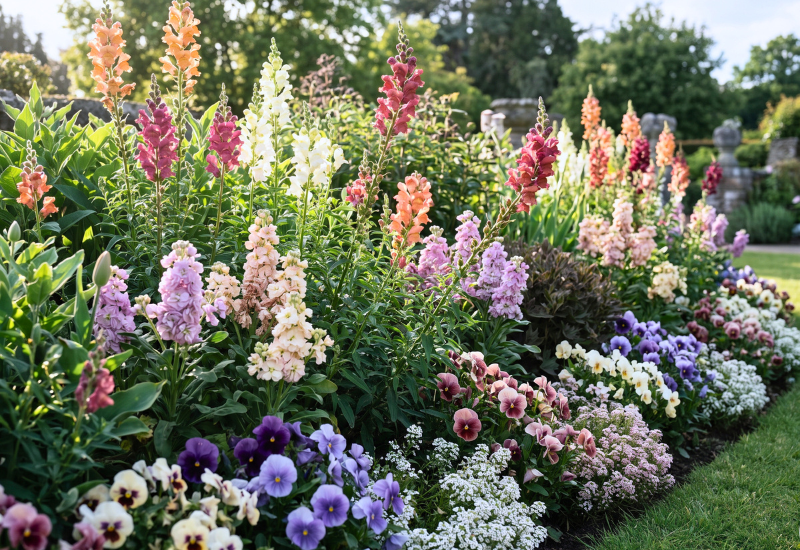
October is the finest month in the flower garden. August is when you earn it.
Not give up — not yet. But there is a quality to a flower bed in late summer that every gardener recognizes: the slight sag of stems that held themselves upright all June, the browning at the edges of things, the sense that the year has turned a corner it cannot walk back around. The tomatoes are finally cooperating. The dahlias are magnificent. And somewhere underneath all that abundance, quietly, the season is counting down.
Which is exactly the moment to tear open a seed packet.
Wait — I mean it. Because here is the thing about August that the garden refuses to tell you directly: the flowers on this list were not built for June. They were built for October. They are cool-season plants, every one of them, and the weather they are about to grow into — September mornings that start to carry a little weight, October afternoons when the light goes gold and the nights drop into the forties — is precisely the weather they have been waiting for all year. The soil is still warm enough to wake them up fast. Everything that comes after is exactly what they need.
This is not a consolation sowing. It is the correct sowing, at the correct time, for the correct plants.
One thing before we meet them. Look up your first frost date — the Old Farmer’s Almanac’s zip code search takes thirty seconds. Count back sixty days. If frost arrives October 15th and you sow this weekend, you have everything you need. Zones 7 through 9 have even more room — several of these will carry past Thanksgiving, one past Christmas in a mild year.
Do the math. Then let’s go — and do not skip the last flower on this list. It is the one most American gardeners have never grown, have probably never heard of, and will almost certainly be ordering again next August without needing any persuasion at all.
1. Pansies (Viola × wittrockiana)

Most gardeners know pansies as spring plants — those cheerful faces crowding the garden center benches in April, irresistible and cheap. And most gardeners watch them burn out by June, the petals crisping at the edges as temperatures climb, the plants stretching and flopping in the heat until there is nothing left worth keeping. So they pull them. And they assume that is simply what pansies do.
It is not what pansies do. It is what pansies do in the wrong season.
Sow pansies in August and you get an entirely different plant — deeper in color, longer in bloom, genuinely at home in the weather it finds itself in. October suits them the way June never could. Those velvety faces in burgundy, gold, violet, and near-black look richer in autumn light than they ever do in spring. In zones 6 through 9 they overwinter as low rosettes and flower again in early March, weeks before anything else stirs. One August sowing buys you two seasons of color. That is the trade most gardeners do not know they are missing.
The one rule: do not direct sow into August soil. The ground is too warm and pansy seed needs cool conditions — around 65 to 70°F — and complete darkness to germinate. Start in trays indoors, away from summer heat, ideally in a basement, garage, or air-conditioned room. Press seed to 1/8 inch deep, cover the tray with cardboard or newspaper until sprouts appear — usually 10 to 20 days. Transplant outside in September as temperatures ease, spacing plants 6 to 9 inches apart.
Honest caveat: germination is slow and requires patience. Do not abandon the tray at day ten assuming failure. Day fifteen, sometimes day eighteen, they appear.
In the border they belong at the front — low, dense, spilling slightly forward. In containers they are unmatched for autumn displays through Thanksgiving. And on the first cool morning of fall, when a bumblebee lands on one and squeezes its way inside, you will feel unreasonably pleased with yourself for having sown them six weeks earlier.
2. Ornamental Kale and Cabbage (Brassica oleracea)
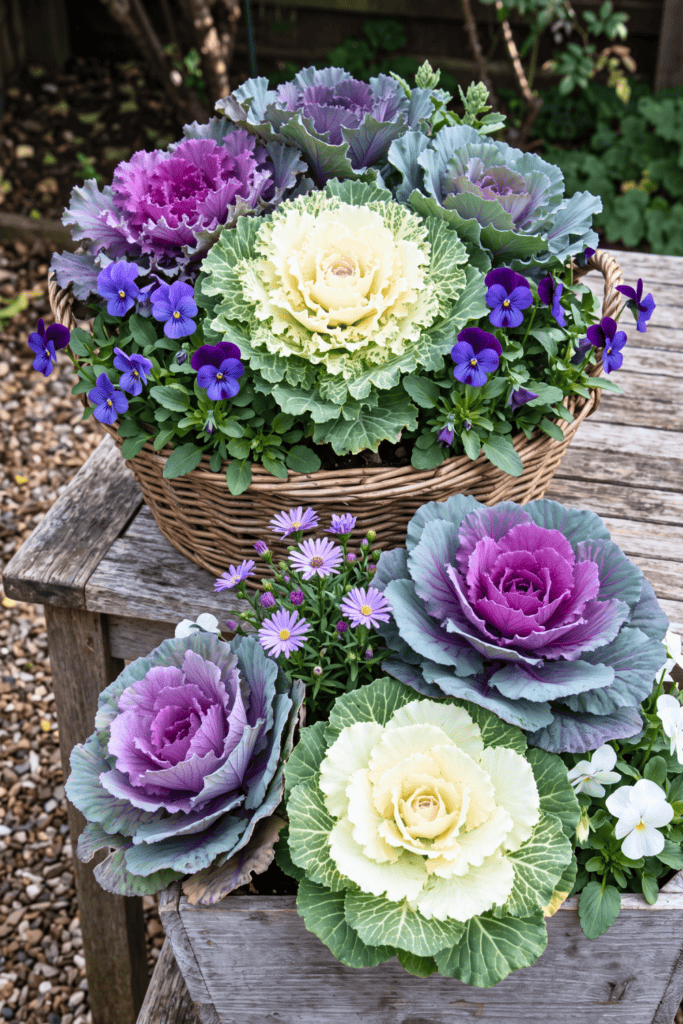
There is a trick built into ornamental kale that almost nobody tells you about, and once you know it, the whole plant makes a different kind of sense.
It does not color up in warmth. Those tight rosettes of cream, rose, burgundy, and blue-green — the ones that look almost too perfect to be real, as though someone has been hand-tinting the leaves — only develop their full pigment when night temperatures drop below 50°F. The cold is not a threat to this plant. The cold is the paintbrush. Sow in August, let the plant establish through September, and then watch October frosts do work that no fertilizer, no special treatment, nothing you could deliberately apply ever could. Each cold night deepens the color a little further. A light freeze that blackens your impatiens leaves will send your ornamental kale into its most saturated, extraordinary display of the entire season.
This is why the timing matters so precisely. Sow too late — September, October — and the plant never builds enough structure before cold arrives. Sow in August and it has the weeks it needs to form that dense, architectural rosette before the temperatures start painting it.
Start in trays or direct sow at 1/4 inch deep, spacing plants 12 to 15 inches apart — they need room to develop their full spread. Thin without mercy; crowded plants stay small and never achieve the bold presence this one is capable of. Full sun produces the best color development.
Honest caveat: cabbage white butterflies will still be laying eggs in August. Check the undersides of leaves weekly and remove any yellow egg clusters before they hatch.
In the border it earns a prominent position — front to mid, where the full rosette can be seen without competition. In containers it is arguably the finest single autumn plant available, carrying color through November and beyond, completely unbothered by conditions that have finished everything else off weeks earlier.
3. Stocks (Matthiola incana)

Cut one stem of stocks and bring it inside. Set it in a glass of water on the kitchen counter and go about your evening. Within an hour the whole room will smell of cloves — warm, sweet, faintly spiced, the kind of fragrance that makes people stop in the doorway and ask what you have been baking. There is nothing else in the annual garden quite like it, and the extraordinary thing is that the scent is most powerful not in summer warmth but in cool autumn air, on October evenings when the temperature drops and the garden goes quiet.
Which is precisely when an August-sown stock will be flowering.
This is the mistake most gardeners make with stocks: they sow them in April with everything else, the plants rush into bloom in warm May, flower briefly and weakly, then collapse into the June heat having never really hit their stride. Stocks do not want warmth. They want exactly what October delivers — cool days, cold nights, and air that carries scent three times farther than summer ever could. An August sowing sends them into that weather perfectly timed, and the result is a plant doing what it was actually designed to do.
One rule above all others with stocks: surface sow. The seed needs light to germinate — pressing it below the soil surface is the single most common reason stocks fail. Lay seed onto damp compost, press it gently to make contact, and do not cover it. Keep the surface consistently moist until germination, usually 7 to 14 days. Sow in individual pots rather than trays if possible — stocks resent root disturbance at transplanting. Space plants 9 to 12 inches apart in the final position.
Honest caveat: not all stocks are fragrant. Single-flowered types carry the strongest scent; some double varieties bred purely for appearance have lost much of it. Look for varieties specifically described as fragrant on the packet — ‘Vintage’, ‘Katz’, and ‘Harmony’ series are reliable choices.
In the border they belong in mid to back positions — stems reach 18 to 24 inches — where that fragrance drifts forward over everything in front of them on a still evening. In the vase they last 7 to 10 days, and a single stem makes a jar of anything else smell like a florist designed it. In zones 7 through 9, plants sown in August will carry through winter and peak again in early spring, giving a second flush at the precise moment it is most welcome.
4. Bachelor’s Buttons (Centaurea cyanus)
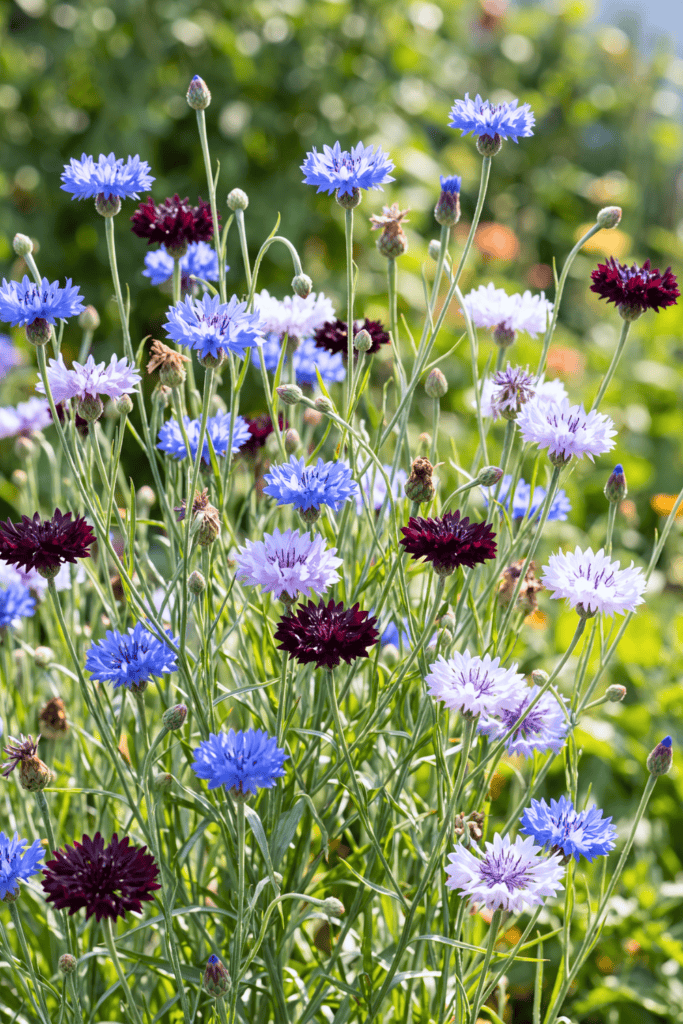
There is a color the garden almost never delivers cleanly — true blue. Not blue-purple, not blue-mauve, but the saturated, unambiguous blue of a clear October sky pressed into a flower the size of a coat button. In a fall garden running on golds and rusts and oranges, that blue is not just beautiful. It is the note the whole composition was missing.
One rule before anything else: do not start in trays and transplant. Bachelor’s buttons make a taproot immediately, and any root disturbance — lifting, squeezing through a cell, teasing apart from neighbors — sends the plant into a decline it rarely recovers from. Generations of gardeners have written them off as difficult. They are not difficult. They simply will not be moved. Direct sow exactly where they will grow, 1/4 inch deep, and thin in place to 9 to 12 inches. Do not touch the roots again.
Days to bloom: 50 to 65 from sowing. An early August sowing blooms comfortably through October.
Honest caveat: tall varieties reach 3 feet and need support after heavy rain. Choose intermediate types for open borders — same color, tidier habit.
In zones 5 through 7 an August-sown plant often overwinters as a small rosette and blooms earlier and more strongly in spring than any March sowing manages. Let a few self-seed and they will do this indefinitely without any help from you.
Bumblebees work them with particular intensity in October when foraging grows urgent. A patch in full fall bloom is one of the most useful things your garden can offer them.
5. Sweet Alyssum (Lobularia maritima)

Kneel down beside a flowering patch of alyssum on a cool October morning and close your eyes. Honey. That is the scent — warm, dark, faintly spiced, entirely disproportionate to a plant barely six inches tall. It is one of the most unexpectedly lovely things the fall garden produces, and most gardeners walk past it without stopping because nothing about its modest appearance suggests what it is doing to the air around it.
The seed is almost invisibly fine. Mix it with a pinch of dry sand before sowing for even distribution — otherwise you end up with dense clumps and bare gaps. Surface sow, do not cover, press gently to make contact, and keep consistently moist until germination. Days to bloom: 45 to 60 — the fastest cool-season plant on this list.
One honest thing to know: alyssum may pause flowering in any remaining August heat and appear to stall. This is not failure. It is the plant waiting. When September temperatures ease, it surges back and does not stop until hard frost.
Spacing 6 to 9 inches; spills beautifully over container edges and softens hard border fronts. Not a cutting flower — its job is the garden and the bees. Hoverflies visit it in extraordinary numbers, and hoverfly larvae eat aphids. Planting alyssum is, quietly, one of the best pest-control decisions you can make.
6. Snapdragons (Antirrhinum majus)

Everyone knows spring snapdragons — the ones from the April garden center that flower briefly, stretch in the heat, and collapse by June looking exhausted. What almost nobody knows is that snapdragons are cool-season plants that spring sowing consistently sends into the wrong weather. August sowing sends them into the right one.
Plants established in September hit their stride exactly as temperatures cool into October — the colors deepen, the stems strengthen, and varieties that looked ordinary in spring warmth become genuinely spectacular in autumn light. In zones 7 through 10 they overwinter and produce a second flush in early spring that surpasses anything grown from scratch.
Start seed indoors — surface sow, as snapdragons need light to germinate. Transplant outside when temperatures drop reliably below 80°F, spacing 6 to 12 inches depending on variety. Days to bloom: 60 to 90.
Honest caveat: tall varieties need staking. Dwarf and intermediate types are self-supporting and better suited to open borders.
The closed lips of each flower require a bee heavy enough to force them open — bumblebees are the primary visitors, the only ones with the weight to trigger the mechanism. Watch one work a row of snapdragons in October and you will sow them every August without needing any further convincing.
7. Calendula (Calendula officinalis)

One plant doing three jobs simultaneously — and doing all three well — is rare enough to deserve its own category. In the border: deep tangerine and gold daisy flowers from September through frost, sometimes beyond. In the vase: long-lasting, cheerful, completely free. In the kitchen and medicine cabinet: petals scattered fresh over salads, dried for tea, infused into skin salves that cost nothing to make and work better than half of what the pharmacy sells.
Every homesteader should grow more calendula than they think they need.
August sowing is the correct timing because calendula genuinely prefers cool weather. A spring sowing flowers briefly in warm May then declines through summer heat — the plant doing a pale imitation of what it is actually capable of. An August sowing hits bloom in September and October, when the color is richest and the petals carry the most resin. That deep tangerine intensifies in cool air the way it never quite does in warmth.
Direct sow at 1/4 inch deep, thin to 12 inches. Dislikes transplanting — sow in final position. Days to bloom: 45 to 60.
Honest caveat: aphids are drawn to calendula in fall. Let them come — it makes an excellent trap crop, pulling aphids away from vegetables while the predators follow close behind.
Self-seeds prolifically. Sow it once and it reappears every year without being asked.
8. Cleome (Cleome hassleriana)
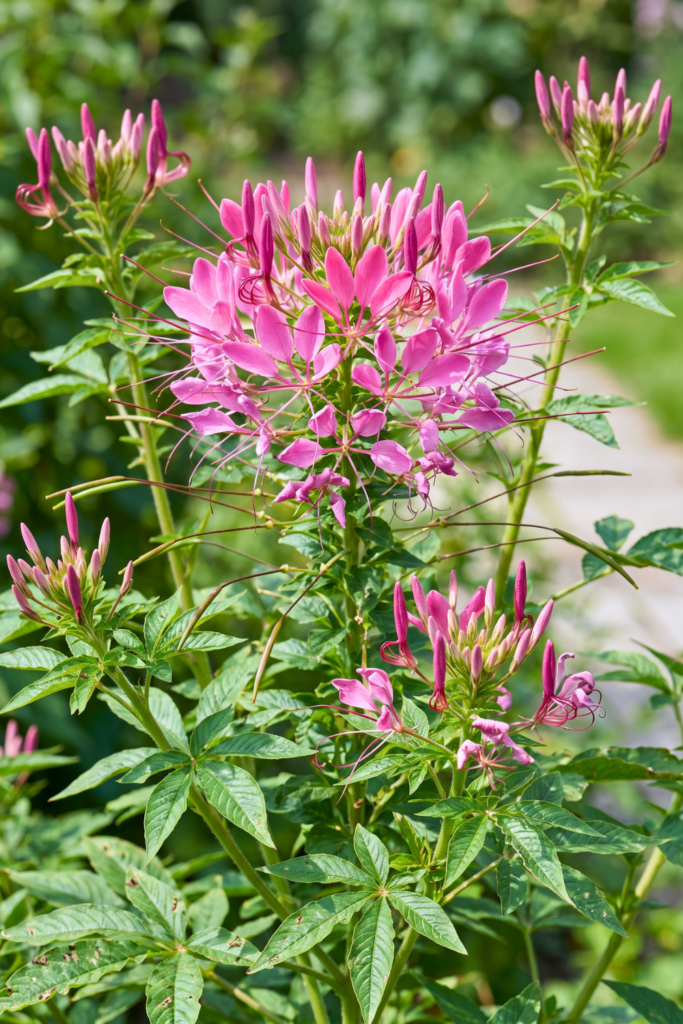
There are not many flowers that make a garden look genuinely wild and abundant at the same time — the kind of planting that stops people on the sidewalk and makes them crane their necks over the fence. Cleome is one of them. Growing 3 to 5 feet tall with large, spidery flower heads in rose, violet, white, and deep cherry — each one a starburst of long stamens radiating outward from the center like something from a botanical illustration — it brings a scale and drama to the August-sown border that nothing else on this list matches. Plant it at the back and it becomes the thing everything else leans toward.
August suits cleome perfectly because the soil is warm enough for fast, reliable germination — cold spring soil is actually the most common reason cleome fails — and the plant has just enough time to establish and begin flowering before temperatures ease into September. Days to bloom: 70 to 80 from sowing, so early August is the window.
Direct sow only — cleome resents transplanting. Press seed to the surface, barely covered, in full sun. Thin to 18 to 24 inches; these are large plants that need room to develop their full presence. Once established they are remarkably drought tolerant.
Honest caveat: cleome self-seeds prolifically — almost aggressively. Deadhead spent flower heads if you want to control where it reappears next year.
Hummingbirds and swallowtail butterflies visit the flowers heavily through September and October, making it one of the most valuable wildlife plants on this entire list.
9. Iceland Poppies (Papaver nudicaule)

The last plant on this list is the one most worth stopping for.
Iceland poppies produce flowers with the texture of crepe paper — translucent, impossibly thin, moving in the slightest breath of air as though they are not quite solid, not quite real. The colors run from white through cream, apricot, salmon, gold, and deep burnt orange, and in autumn light, low and golden and coming in at an angle, they are among the most purely beautiful things a garden can grow. Most gardeners have never sown them. Most gardeners do not know they can be sown in August. Both of these facts are worth correcting immediately.
This plant behaves differently by zone, and the honest approach is to say so directly.
Zones 7 through 10: Sow in August and Iceland poppies will be blooming by November, carrying through winter and into spring. These are winter-spring annuals in warm climates, and August is the beginning of their entire season. This is not a consolation prize for missing spring — it is the correct and best time to grow them.
Zones 4 through 6: An August sowing germinates and builds a rosette of ferny blue-green leaves before frost arrives. That rosette overwinters, and the plant blooms in early spring — earlier and more prolifically than any March sowing manages. Think of it as a letter to your April self, written in August and delivered exactly when it is most needed.
Surface sow or barely cover — seed needs light. Handle seedlings carefully, roots are sensitive. Sow in final position or individual biodegradable pots. Days to bloom: 60 to 90.
Bees visit the open, pollen-rich centers freely — no mechanism, no barrier, nothing between the flower and whoever arrives first.
10. Nemesia (Nemesia strumosa)

Most American gardeners have walked past nemesia in the garden center without recognizing it — which is a genuine loss. Up close, the individual flowers look like something a jeweler designed: two-lipped, slightly asymmetrical, each one marked with a contrasting throat in a different color from the petals. White with a lemon eye. Deep crimson edged in pale cream. Soft apricot shading through gold to burnt orange at the center. Somewhere between a tiny orchid and a snapdragon that decided to be more interesting. A full plant in bloom stops people who cannot name it, and the first question is always the same: what is that?
Like everything on this list it is a cool-season plant, and like several of them it stalls in summer heat — giving it an undeserved reputation for difficulty. August sowing sidesteps this entirely. Seed goes in while soil is still warm enough for fast germination. The plant establishes through September. October arrives and the whole thing opens into bloom as though it has been planning this moment all along.
Surface sow indoors onto damp compost — seed needs light and cool conditions around 65°F to germinate. Transplant outside when temperatures ease in September, spacing 6 to 9 inches. Days to bloom: 60 to 70.
Honest caveat: not widely stocked in US garden centers. Order seed online — the named variety range in specialist catalogs, from pale ‘Innocence’ to jewel-toned ‘Sunfire’, makes the extra step immediately worthwhile.
Front of border or containers. Fragrant varieties carry a soft vanilla and honey scent — plant them anywhere people slow down and linger.
