

You have been watering that patch for two weeks. You are giving it more and more water, the way you were taught to water the lawn. And the problem is getting worse.
This is your first clue here. Drought-stressed lawns usually react positively to watering. If you have a patch of the lawn that ignores any efforts to water it and continues spreading even after you have applied sufficient amounts of water, then it means that you deal with the problem that is not connected to the lack of water at all. This patch is being attacked by some sort of underground pest which you can only find when you look for it.
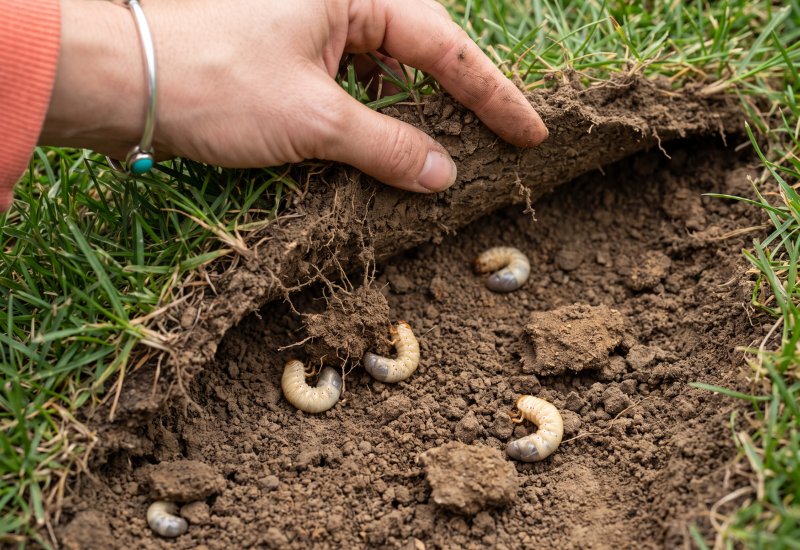
The month of August is when it becomes obvious for you. The grubs (Japanese beetle larvae and/or chafer larvae) that hatched in July have been feeding on the grass roots for the last couple of weeks and by now they have caused enough damage to make the problem evident. Your patches of yellowed grass will form irregular shapes that are not related to your watering habits in any way. You will be able to pick some of these patches up from the ground with no effort at all.
If you had already battled Japanese beetles on your roses and raspberries earlier this year, then this is the second part of the story which takes place underground and is revealed only when August comes around. Let us try to figure out what is going on here.
1. The Tug Test — If the Grass Lifts Like Carpet, You Have Your Answer
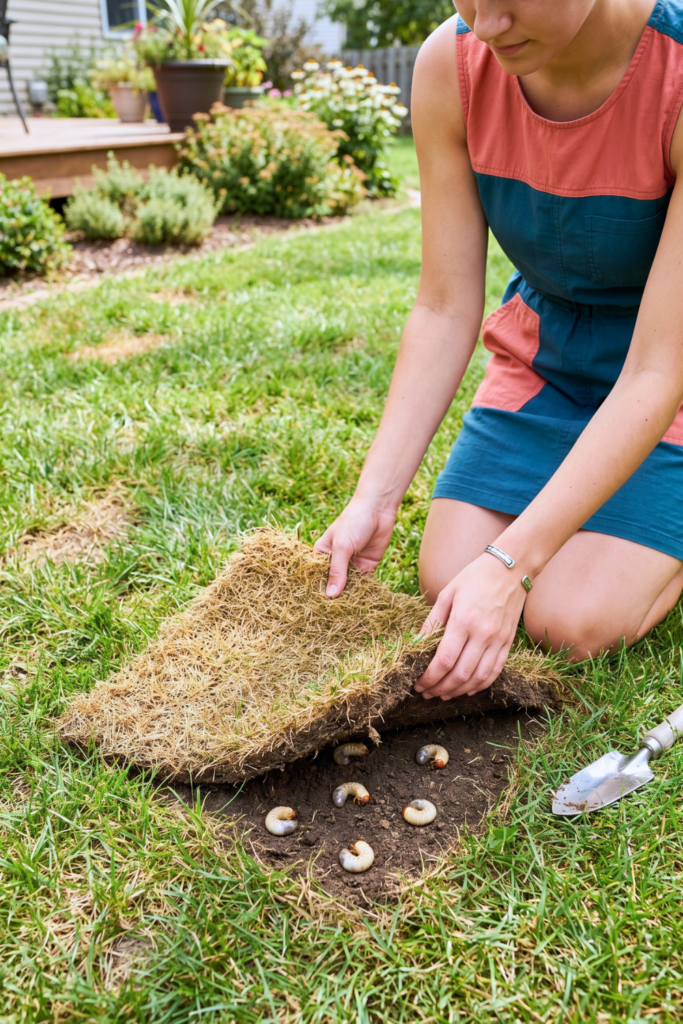
Stop wasting time trying to figure out what’s happening and make your life easier; there is a single test that solves the problem in ten seconds and leaves you nothing but some strength in your hands.
Walk up to the patch, put your fingers into the soil-grass junction and try pulling the blade. On healthy turf, even in the state of drought, the roots will hold on tight; you might feel some resistance, perhaps rip off some blades, but the grass will remain firmly planted. However, on a lawn attacked by grubs, there will be no resistance whatsoever; the blades will simply roll back like a carpet since the roots responsible for holding them in place have been devoured by the pest.
The reason is simple – grubs eat only root tissue right beneath the ground surface, thus cutting off the connection between the blades and the soil. This is something that drought cannot do – a droughty lawn has intact roots, just under-watered ones.
Try doing the test not only at the center of the patch but along its edges as well; grub colonies expand outward and sometimes the edges give you more information than the center itself. If it rolls up easily at several points, stop trying to water it right now; the more irrigation you will apply, the more resources you will waste on feeding the pest.
Now that it is clear that you are dealing with grub attack, cut a one-square-foot piece of grass from the damaged area and pull it up. If there are more than 5-6 pests per square foot, it means that the threshold considered harmful has been reached and it’s high time you did something about it. Start with beneficial nematodes if the soil is warm enough, or use a curative grub control product labeled specifically for the species you deal with.
2. Irregular, Spreading Patches — Not the Neat Rings Drought Leaves Behind
Now, take a step back and consider the shape of the affected area in addition to the coloration.
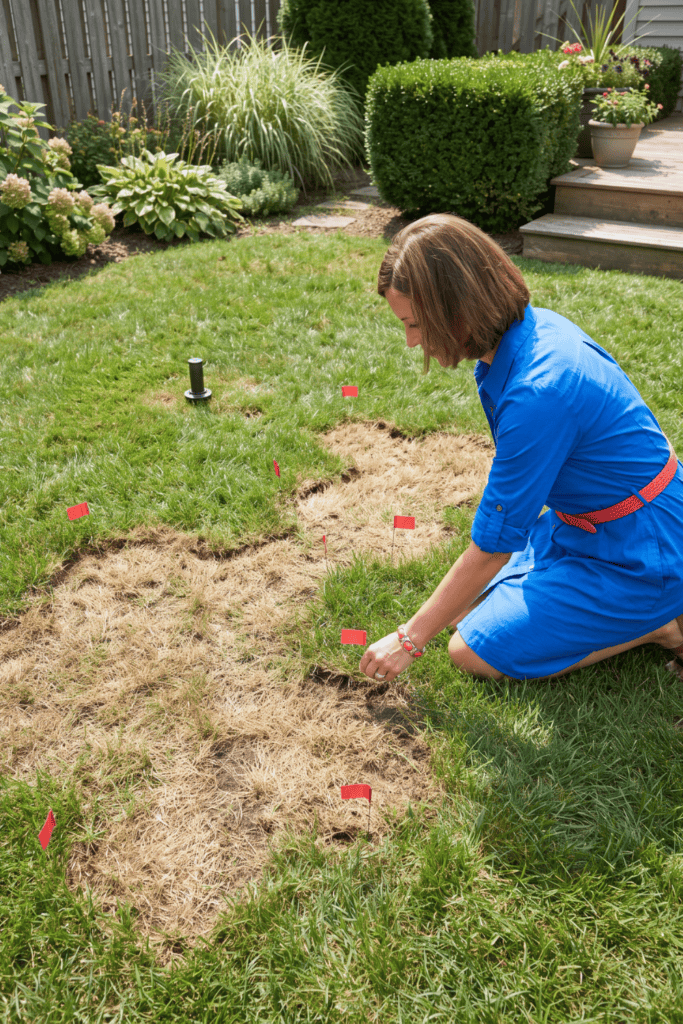
Damage from drought appears honest — it follows the pattern of your watering schedule. You can find it in places where the sprinkler does not reach, on straight lines of the hose spray or uniformly throughout a slope where water runoff occurs before it gets to soak in the ground. This stress has a methodical approach, which you should be able to predict if you consider your lawn from above. The damage caused by grubs, on the other hand, is completely unorganized — it appears as irregular, amoeba-like patches without any consideration of your sprinkler heads. It creeps along every day and in whatever direction your grub population is feeding. In the course of a week or two, two patches that initially formed separately will combine into a larger dead patch. This is the simple colony extending its feeding area, not deteriorating conditions.
This is an important distinction because it determines whether the addition of water will help. In this case, it won’t, as a grub colony does not care how moist the soil becomes in relation to the roots that have already been eaten.
If you see patches that grow and merge with other affected areas instead of remaining stationary, mark the current borders of the affected patches today using small markers or stakes. Check again in three to four days. If there is any sign of expansion of the patches, this confirms an active, spreading infestation and not a static drought stress area — and, in this case, a curative treatment (grubs’ nematodes or a labelled grub killer applied immediately per directions on the label) must be performed right away, not after the rain, since every day means another day of feeding and another lost root system before cold soil slows them down for the winter.
3. Increased Animal Activity — Skunks, Raccoons, and Birds Are Doing Diagnosis for You, Free
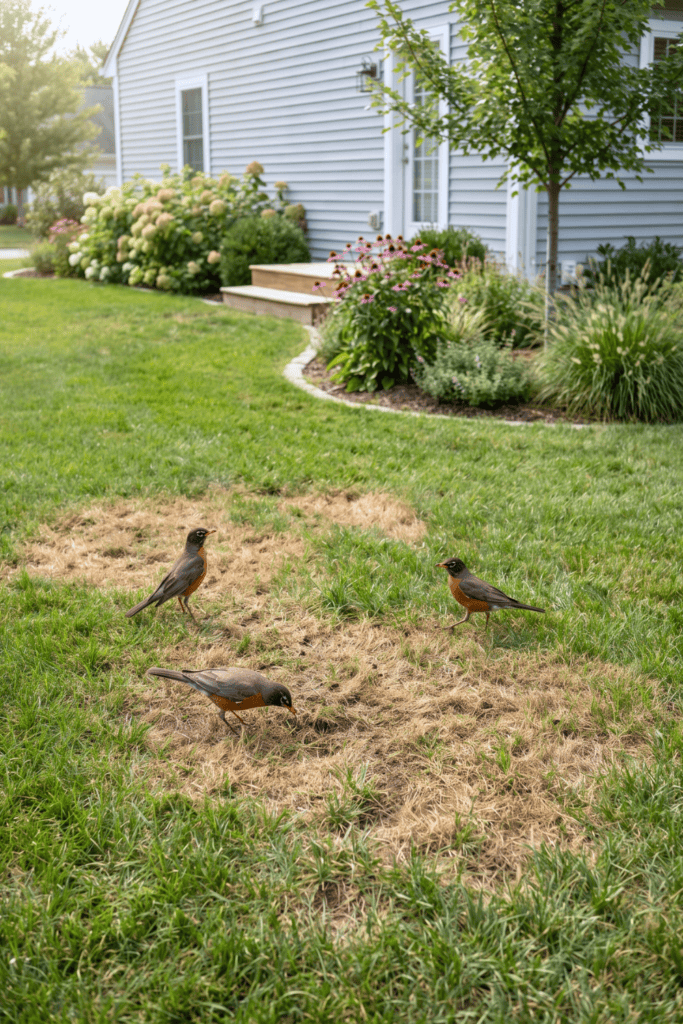
Some kind of creature has been rooting up your lawn at night, and that’s not something that’s unrelated to your patches of brown grass. In fact, it’s your answer, brought to you courtesy of an animal that discovered the grubs before you even knew they were there.
Skunks and raccoons are perhaps the most reliable of all early warning systems for grub infestations; none of the two animals is known for being discreet about it. They root at night, digging up patches directly over grub colonies; the creatures can sense grubs several inches below the surface, and what they’re doing is simply digging up their supper. Crows and other bird species do exactly the same thing during daylight hours, except using their beaks, poking and pecking at the turf until it’s as if small-bore buckshot hit it. This does not happen to grass that is suffering from drought conditions. There is nothing underneath the brown grass, which will simply sit there, so it’s no attraction to any kind of digger.
The patchy damage may look frightening, but it’s valuable information. Those animals are telling you that there is an active population, and that it is concentrated somewhere in that area.
Don’t just go ahead and rake everything flat and leave it at that. Consider the area to be a verified infestation ground, and treat it with either beneficial nematodes or some curative grub control product in a week’s time. Even late August should provide enough warmth to the soil in most parts of the US for either method to take effect. Once the population gets depleted, the digging will automatically stop after one or two weeks since there won’t be anything to attract those animals anymore.
4. Damage That Shows Up Despite Regular Watering — The Sign Most Gardeners Misread the Longest
This is the one that requires the most time, since it mirrors your existing problem.
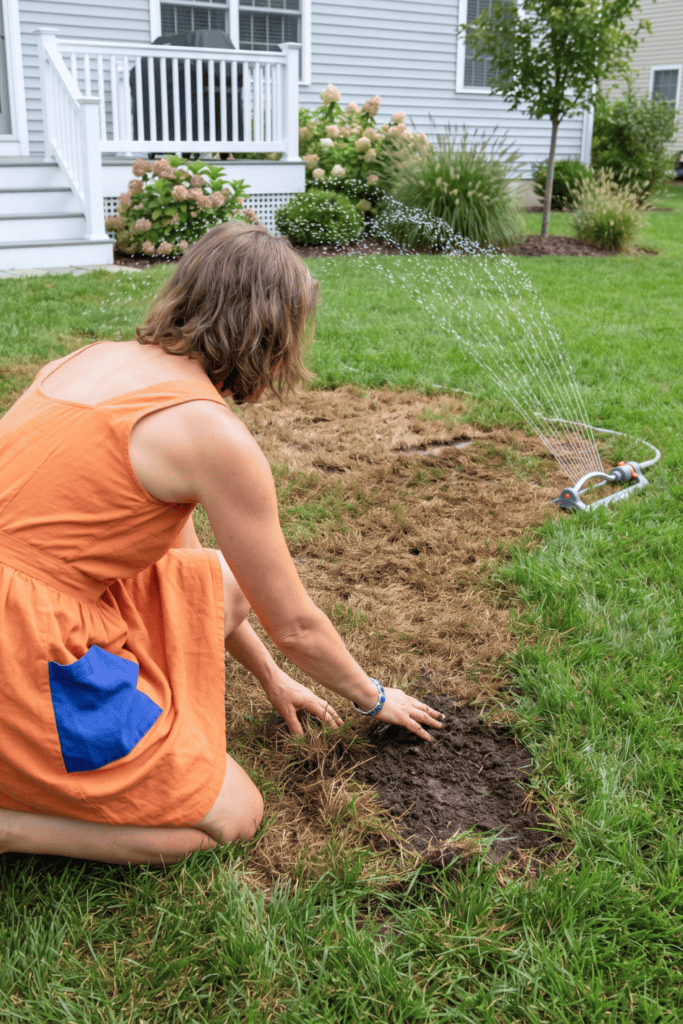
You’ve been watering regularly, and perhaps even boosted the amount, but the lawn hasn’t responded yet. For the vast majority of people, the first thought would be “Well, maybe we just aren’t irrigating enough” – and so they boost their watering schedule further, resulting in higher bills, without making any progress in terms of greening up their yard. This thought is quite reasonable for most other situations in your garden, but is absolutely incorrect here. If a lawn does not react to regular and sufficient irrigation within one-two weeks, it means that the problem is not about the lack of water; something prevents grass from using it.
Grubs cut the roots of your lawn faster than the lawn grows new ones, meaning that water you provide is falling on the ground that your lawn cannot use anymore. It’s, in some sense, similar to filling a bucket with holes in its bottom; you add more water in hope to see a result, but the system that holds the water where it’s supposed to be was literally destroyed.
Track this for additional proof: apply regular and thorough watering for five-seven days and observe if there is any improvement in the problem area. If the answer is negative, then don’t try to irrigate your lawn more – it won’t help, and overwatered lawn may experience additional problems due to fungi. Instead, perform tug test from Sign #1 right in this area: if the grass pulls out easily, then you need to move straight to solving the problem – nematodes or grub control product, both should be applied now while soil is still warm enough for this procedure.
5. Spongy, Springy Ground Underfoot — Your Lawn Feels Different Before It Looks Different

Not always do you see the problem before your feet tell you about it. The latter is one of the most reliable symptoms that appear about a week or even two earlier than you’ll see the brown spots — the best advance warning you can get before the real trouble starts.
Step on the damaged area to get a sensation of how it feels and does not look like. Normal turf is firm and gives a bit to touch, just like a mattress should be: it is supported from inside and feels strong. An area damaged by grubs will feel very differently: it will be soft and spongy; it might even seem to you as if there was a puddle here since the layer of soil that used to be firm thanks to its root mat will be either thinning or simply broken. In serious cases, the soil will feel as if it was air-filled and could fall apart under your feet. The latter happens due to the fact that grubs managed to detach a layer of turf from the soil, although you still see no changes yet.
The drought stressed turf will feel completely different, since it is dry and crisp rather than soft and spongy.
It is recommended to make this inspection a part of your routine every several days in August: walk barefoot or with thin-soled shoes on your lawn to feel if there is something different among the areas on the lawn. Getting a clue of sponginess early — before a single blade of grass becomes brown — will give you a head start in grub fighting. Apply the necessary measures immediately after you feel sponginess and you’ll deal with the small and contained colony rather than the large one spread out for several weeks.
6. The Square-Foot Grub Count — The Only Test That Gives You a Number, Not Just a Guess
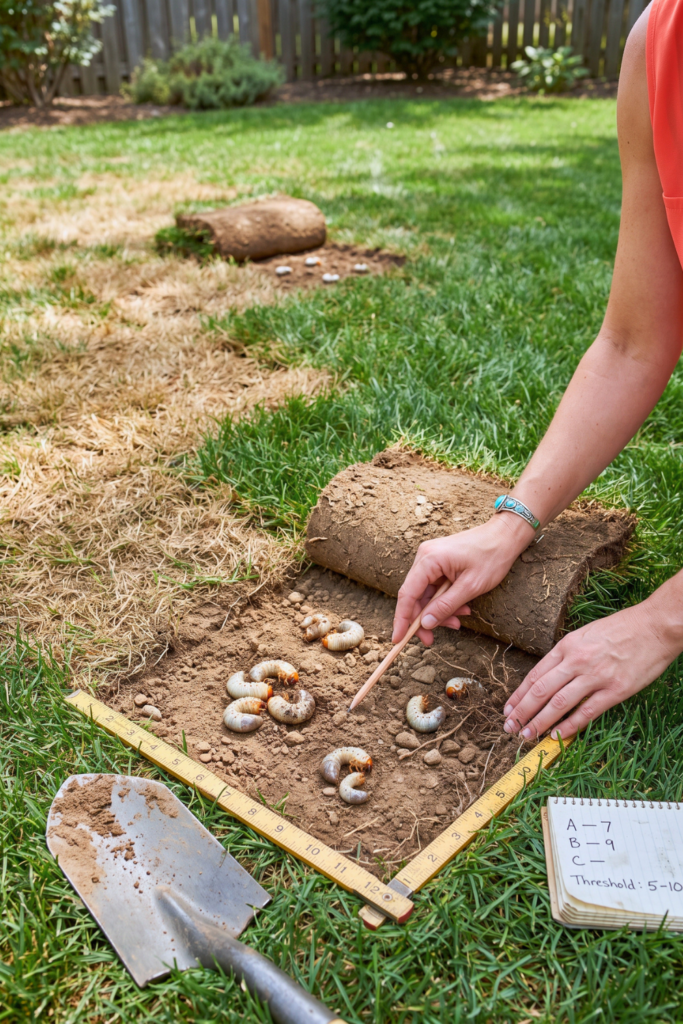
So far, everything mentioned has shown you whether you are dealing with grubs or not. However, now it comes to the number of grubs, which is what determines the necessity of taking action.
Choose one location along the perimeter of the affected area where dead and alive grass intersect and cut three sides of a one-foot square turf with a spade; then lift the turf in a manner resembling a flap. Go through the upper layer of soil, two or three inches deep, and count each individual white, C-shaped grub. This number is the only one you have in front of you and this number is the most objective diagnosis that can be made by a home gardener; turf specialists use it because it leaves no room for guessing. The majority of extension services set the level of threshold at 5-10 grubs per square foot, and this is the limit above which a healthy and well-rooted lawn cannot compensate for root loss and continue regenerating despite watering. Below this limit, you do not have to treat because the lawn will be able to recover without any additional care.
Make this test in two or three different places in the damaged area. It should be considered that grub populations are unevenly distributed on a lawn, and a single sample may underestimate or overestimate the real situation on the lawn.
In case of the counts being at or above threshold, now you get a go-ahead signal to take immediate actions, be it application of beneficial nematodes, in which case you should water them in and keep them moist for two weeks, or an application of the recommended grub control products according to the label. In any case, it is possible to treat with either one or another product due to still relatively high soil temperature in August; however, every week brings fall closer, and soon you will lose the opportunity.
7. Damage Hugging Driveways, Sidewalks, and Sunny Edges — And When It’s Time to Stop Being Gentle
Consider where the problem began, and not simply where it has reached its current extent. There is a favored starting point for grub damage, but it is almost never in the middle of the lawn.
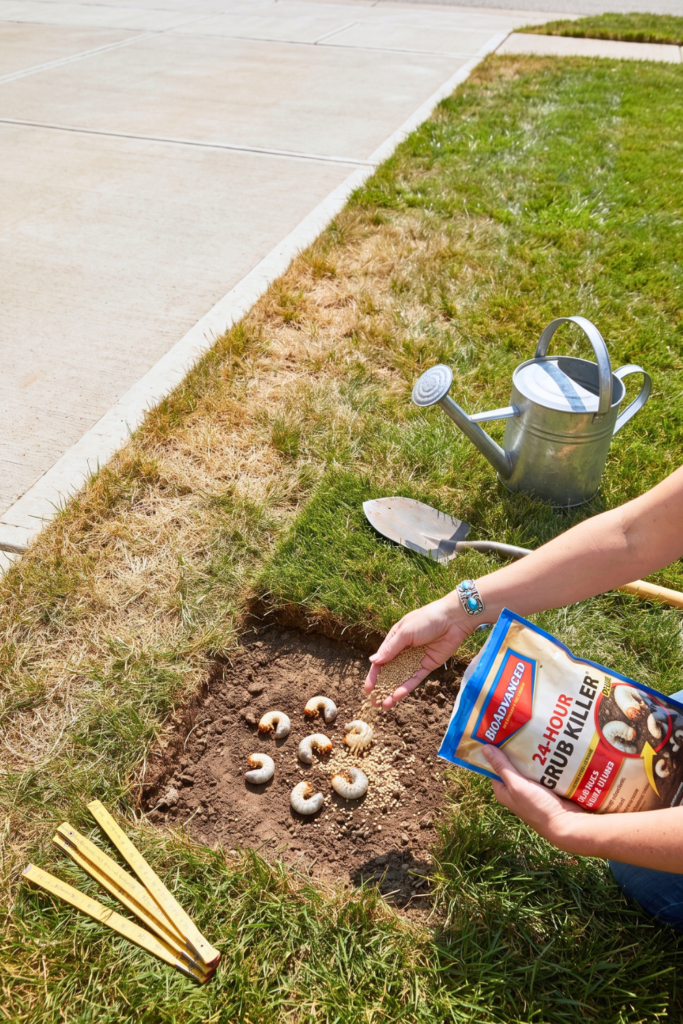
Adult beetles will seek out warm, dry soil in order to deposit their eggs, so it’s common to see the worst damage occur along the strips of turf along driveways, sidewalks, and the south sides of your lawn, which heat up more quickly and hold less moisture than other parts of your lawn. If your damaged area happens to fall along the edge of the driveway or south side of the lawn and then elsewhere, that isn’t happenstance. It’s precisely where the beetles chose to lay their eggs, and where those grubs have been munching on the roots right under the surface all summer long. Drought stress makes no such distinction; it is simply where your sprinklers aren’t reaching their mark.
If you’ve confirmed an infestation using the tug test or square-foot count and you’re seeing a lot of them — and especially if it’s late August when there’s very little time left for grubs to migrate deep below the frost line — this is the moment where a more gradual biological method of control may simply not be sufficient. For situations where speed is of the essence and you have a heavy infestation of grubs, a faster-acting granular pesticide such as the BioAdvanced 24-Hour Grub Killer Plus (with trichlorfon as the active ingredient) that will kill grubs within 24 hours is preferred over nematodes which may require several weeks to become effective. Water it in right away after application, and use it only in heavy infestations; for lesser numbers of grubs, nematodes or milky spore disease remains the better option.
