


Most gardens fail for the same reason: we train plants to be weak.
Frequent watering, constant feeding, perfect soil — all those “care” habits create roots that never learn to search deeper. So when summer hits 95°F, they collapse, no matter how much effort we pour in.
Meanwhile, out in the wild, native flowers are doing the opposite. They’re thriving in cracked clay and wind-baked gravel with no irrigation at all. Their strength isn’t luck — it’s design. Deep taproots chase moisture feet below the surface, leaves tighten their pores to save water, and bloom cycles sync perfectly with rainfall. They don’t survive despite neglect — they survive because of it.
If you’re tired of needy plants, here’s the smarter route: start with species that already know how to live without you. These 13 native U.S. flowers aren’t trendy imports or “drought-tolerant” marketing gimmicks — they’re the originals that built American landscapes long before sprinklers existed. Plant them once, give them a season to settle, and you’ll spend next summer enjoying blooms instead of dragging a hose.
1. Dalea formosa (Feather Dalea)

Soft-hued and quietly resilient, Dalea formosa bursts into lavender-pink bloom just when the summer heat drains everything else. Fine, silvery foliage catches the light and moves with the wind, giving dry borders and rock gardens a gentle shimmer instead of heaviness. Despite its modest size, it brings rhythm and color exactly when most perennials fade, standing out as one of the desert’s most graceful performers.
A member of the Fabaceae family, Feather Dalea naturally improves soil by fixing nitrogen around its roots. Its deep taproot anchors it into gravelly ground, drawing moisture from layers most plants can’t reach. Each leaflet is finely divided to limit water loss — a perfect design for surviving drought without stress. Native to the American Southwest, it has learned to thrive on scarcity, not care. Once rooted, it blooms freely through weeks of heat and wind with almost no help.

Pair it with Salvia greggii, desert marigold, or blue grama grass for a soft, heat-tolerant palette. Feather Dalea keeps its rounded form year after year, adding both texture and ecological value to any low-water garden.
2. Asclepias tuberosa (Butterfly Weed)

Fiery orange blooms and upright stems make Asclepias tuberosa impossible to ignore. Its flower clusters glow through midsummer, drawing every passing butterfly into a slow dance of color. Despite the vibrant display, this milkweed is as rugged as they come—thriving in lean soil, full sun, and long, dry stretches where most ornamentals fade.
A deep, tuberous root gives the plant its drought resilience and name. Unlike other milkweeds that prefer damp meadows, Butterfly Weed evolved across dry prairies and sandy roadsides, adapting to store moisture underground and push new growth even after scorching heat. Once settled, it resents disturbance or excess water; the less attention you give it, the better it performs.
In a home garden, it fits beautifully into native wildflower mixes, pollinator borders, and prairie-style plantings. Pair it with Coreopsis lanceolata, Echinacea pallida, or Schizachyrium scoparium for a dynamic, low-water combination that looks effortless all summer long.
3. Monarda fistulosa (Wild Bergamot)

Soft lavender blooms held in whorls above fragrant foliage make Monarda fistulosa a summer highlight in any low-water border. The flower heads attract a constant shimmer of bees, butterflies, and hummingbirds, giving dry gardens a pulse of movement. Its mint-like scent adds an herbal freshness that lingers in the air after rain, blending beauty with subtle utility.
A native of open prairies and dry woodlands across North America, Wild Bergamot belongs to the Lamiaceae family, sharing its aromatic oils with other drought-resilient herbs. Its square stems and opposite leaves reveal that heritage, while the plant’s dense root system helps it anchor in thin soil and conserve moisture through heat waves. Unlike hybrid bee balms that demand rich beds and steady watering, this species stays strong in lean, sun-exposed ground.

Use Wild Bergamot to connect ornamental borders with meadow plantings or pollinator strips. It pairs naturally with Echinacea pallida, Rudbeckia hirta, or native grasses like Schizachyrium scoparium. Once it settles, occasional trimming after bloom is the only maintenance it asks for—everything else, it handles alone.
4. Penstemon digitalis (Foxglove Beardtongue)

Elegant white blooms rise above tidy clumps of glossy foliage, giving Penstemon digitalis a refined presence that belies its toughness. Through early summer, its tubular flowers shimmer in sunlight and invite every pollinator in sight—especially bumblebees that disappear completely into the blossoms. The upright stems stay clean and architectural, making it an easy fit for formal borders or naturalized meadow plantings alike.
Native to open prairies and glades of the central and eastern United States, this long-lived perennial has evolved to handle lean soils and erratic rainfall. Its fibrous roots knit tightly into the ground, preventing erosion while reaching deep for residual moisture. Belonging to the Plantaginaceae family, Penstemon digitalis thrives without extra fertilizer or irrigation once established, maintaining a graceful shape even through heat and drought.

In design, it pairs beautifully with Coreopsis verticillata, Echinacea pallida, and warm-season grasses like Sporobolus heterolepis. The airy seed heads that follow flowering add texture long after the color fades, extending the plant’s value into fall.
5. Symphyotrichum oblongifolium (Aromatic Aster)
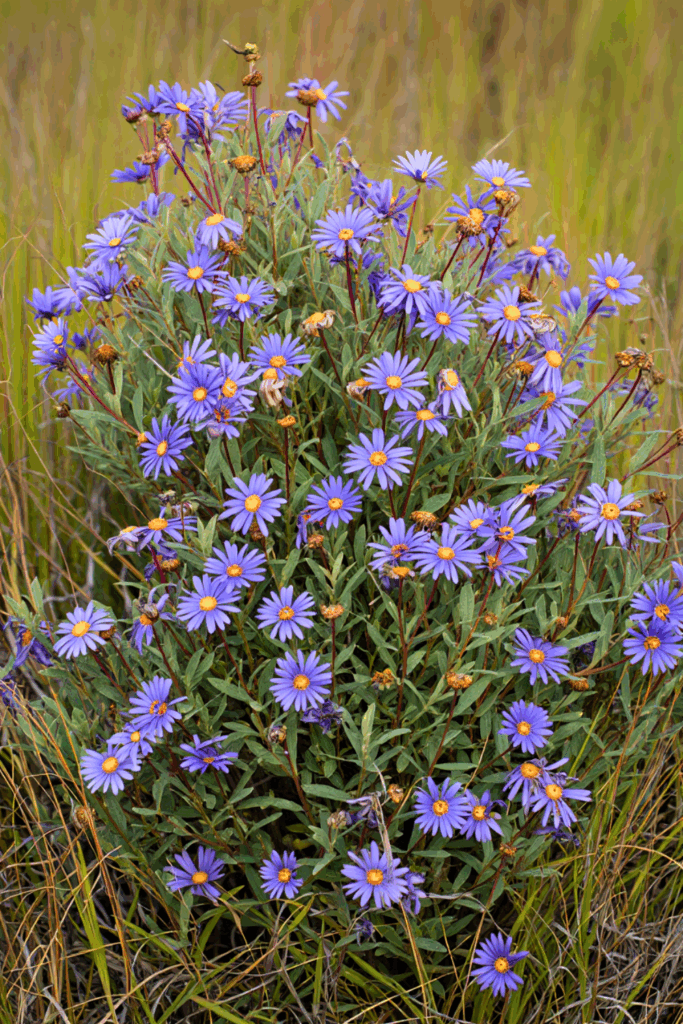
When most gardens fade into dull browns at the end of summer, Symphyotrichum oblongifolium bursts to life in waves of violet-blue. Its dense sprays of daisy-like flowers cover the plant so completely that the foliage nearly disappears, bringing color and pollinator activity right through fall. The leaves release a light, resinous fragrance when brushed, giving this aster both visual and sensory charm.
Native to dry prairies and rocky slopes of the Midwest and Great Plains, Aromatic Aster evolved for endurance. Its woody base and branching stems keep it sturdy against wind and drought, while narrow leaves with a waxy coating reduce water loss during heat spells. Belonging to the Asteraceae family, it provides crucial late-season nectar for bees and butterflies when few other plants are in bloom. Once established, it asks for almost nothing except sunlight.

In gardens, it’s an easy fit for naturalistic borders, meadow-style plantings, or the front edge of mixed shrub beds. Pair it with Schizachyrium scoparium (Little Bluestem) or Solidago rugosa for a glowing fall display that needs no irrigation and no rescue.
6. Phlox subulata (Moss Phlox)

In early spring, when the rest of the landscape is still waking up, Phlox subulata spills over walls and slopes in a carpet of color. Shades of pink, lavender, or pure white form dense mats of star-shaped blooms that look almost luminous under full sun. Its low, spreading form creates the effect of a living tapestry, softening stone edges, curbs, or dry banks that many plants can’t handle.
Native to the eastern and central United States, Moss Phlox belongs to the Polemoniaceae family and has adapted perfectly to lean, rocky soils. Its needle-like evergreen leaves help conserve moisture, while its roots weave tightly into the surface layer, anchoring it even on steep ground. Once established, it tolerates heat and extended dry spells with ease, needing little more than seasonal grooming to stay dense and vibrant.

Use it as a natural groundcover in full-sun rock gardens or to cascade over retaining walls and garden paths. For a drought-hardy spring display, combine it with Sedum acre, Iberis sempervirens, or Dianthus gratianopolitanus.
7. Yucca glauca (Soapweed Yucca)

Architectural and unflinching, Yucca glauca brings sculptural drama to any dry landscape. Its narrow, blue-green leaves radiate from a tight rosette, forming a living sculpture that catches every glint of light. In early summer, tall flower stalks rise with creamy white bells that sway gently above the foliage, turning even the harshest setting into something quietly elegant.
Native to the Great Plains and western states, this hardy evergreen has spent millennia adapting to extremes—wind, drought, and thin, alkaline soils. Its deep taproot and thick, fibrous leaves store enough moisture to outlast months without rain, while its waxy cuticle seals humidity inside. Belonging to the Asparagaceae family, it also supports a fascinating ecological relationship: the yucca moth, its exclusive pollinator, depends entirely on these blooms to reproduce. Once established, Soapweed Yucca thrives on total neglect.

In design, it works beautifully in gravel gardens, xeric borders, and minimalist front yards where structure matters more than volume. Pair it with Penstemon digitalis, Bouteloua gracilis, or Echinocereus triglochidiatus for a modern desert palette that looks sharp year-round.
8. Melampodium leucanthum (Blackfoot Daisy)

Few plants capture the spirit of the Southwest like Melampodium leucanthum. Its small white daisies, each with a soft yellow eye, bloom tirelessly from spring through fall, even in the toughest heat. The flowers form a low, rounded mound of silvery foliage that stays neat without trimming, giving rock gardens, dry borders, and curbside plantings a fresh, effortless look.
Native to the dry grasslands and limestone hills of Texas and northern Mexico, Blackfoot Daisy has evolved for endurance. Belonging to the Asteraceae family, it carries narrow, gray-green leaves coated in fine hairs that reflect sunlight and slow water loss. Its roots spread wide rather than deep, capturing brief rain efficiently and holding the plant steady through dry spells. Once established, it thrives on neglect—too much water or fertilizer will shorten its life.

Use it to brighten gravel beds, pathway edges, or containers where drainage is sharp. Its compact form and long bloom season make it a perfect companion for Dalea formosa, Gaillardia pulchella, or Calylophus hartwegii.
9. Agastache rupestris (Sunset Hyssop)

Few perennials match the color play and perfume of Agastache rupestris. Its slender spikes open in brilliant shades of orange, coral, and rose, fading to smoky mauve as the season cools. The gray-green, aromatic foliage releases a minty-citrus scent in the heat, turning every breeze into a moment of freshness. Even at the height of summer drought, it stays upright and alive with motion—visited constantly by hummingbirds and native bees.
Native to the high deserts of Arizona and New Mexico, Sunset Hyssop is built for extremes. As a member of the Lamiaceae (mint) family, it carries essential oils that naturally reduce water loss, while its fine, silvery leaves reflect intense sunlight. A deep root system anchors it against dry winds and gives it remarkable longevity in poor, stony soil. Once established, it resents overwatering and thrives best when ignored.

Use Sunset Hyssop in gravel beds, raised planters, or the middle of a dry border for a vertical accent of color. It pairs beautifully with Penstemon digitalis, Gaura lindheimeri, and ornamental grasses like Bouteloua gracilis.
10. Callirhoe involucrata (Winecup Mallow)

Low, sprawling, and endlessly charming, Callirhoe involucrata forms a living carpet of magenta color through the hottest months of the year. Its cup-shaped blooms open in the morning and track the sun across the sky, giving beds and borders a fresh burst of life even in July heat. The velvety, lobed leaves stay cool to the touch and hold their color through drought, creating a cushion of green that softens stone edges and gravel paths.
Native to the prairies and open plains of the central United States, Winecup Mallow is part of the Malvaceae (mallow) family, related to hibiscus and hollyhock. It survives harsh conditions through a thick, tuberous root that stores moisture underground, allowing it to rebound after weeks without rain. Once settled, it asks for nothing more than sunlight and drainage—too much water or fertilizer quickly spoils its rhythm.

Perfect for sunny slopes, rock gardens, or the front edge of a native border, it spills gracefully over walls and planters while attracting pollinators all season. In poor soil and full sun, it performs at its best—proof that beauty doesn’t always need comfort.
11. Calylophus hartwegii (Texas Sundrops)

When the afternoon sun drives most flowers to close, Calylophus hartwegii begins to glow. Its butter-yellow blooms unfurl in the fading light, catching the last warmth of the day and turning dry borders into pools of soft color. The flowers stay open through evening and early morning—an adaptation that conserves energy and moisture—before folding as heat intensifies again.
Native to the arid plains and limestone hills of Texas and the Southwest, Texas Sundrops belong to the Onagraceae (evening primrose) family. Its narrow gray-green leaves reduce surface area for evaporation, and a deep root system anchors the plant firmly against dry winds. Once established, it shrugs off long droughts with ease and continues blooming through thin soil, full sun, and high temperatures.

In design, Texas Sundrops works beautifully at the front of dry borders, in rock gardens, or along driveways where reflected heat challenges most plants. It pairs effortlessly with Blackfoot Daisy, Winecup Mallow, and Gaillardia pulchella for a native, low-water mix that looks lively from spring to fall.
12. Helenium amarum (Bitter Sneezeweed)

Don’t let the name fool you—Helenium amarum is one of the most cheerful and resilient native wildflowers for dry, open spaces. Covered in golden-yellow button blooms from mid-summer through fall, it brings a cloud of color that moves with the lightest breeze. Its fine, threadlike foliage gives it an airy, meadow-like presence, softening the edges of gravel beds and sun-drenched borders.
Native to the central and southern United States, this member of the Asteraceae family evolved in dry prairies and disturbed soils where only the hardiest plants survive. Its wiry stems and narrow leaves minimize water loss, while its deep, fibrous roots anchor it through long droughts. True to its prairie origins, it thrives in poor, thin soil and declines if pampered—fertilizer or rich compost only shorten its bloom time. Once established, it can flower continuously without supplemental water.

Use Bitter Sneezeweed in naturalized meadows, roadside-style plantings, or large sunny beds where texture and movement matter. Its compact, dome-like form mixes well with Gaillardia pulchella, Coreopsis tinctoria, and native grasses for a low-maintenance burst of sunshine.
13. Verbena stricta (Hoary Vervain)

Rugged yet graceful, Verbena stricta brings soft vertical rhythm to dry gardens with its tall spikes of violet-purple blooms. Flowering begins at the base and moves upward through summer, creating a steady display that attracts clouds of butterflies and native bees. Its silvery-green, softly textured foliage holds up through intense heat, giving borders a wild yet intentional look.
Native to the prairies and open fields of central North America, this hardy member of the Verbenaceae family is built for survival. Its deep, branching roots pull moisture from dry subsoil, while fine hairs on the leaves slow evaporation and reflect sunlight. Hoary Vervain thrives where other perennials quit—poor soil, full sun, and long gaps between rain. Once it takes hold, it needs almost no attention and will often self-seed modestly, filling empty spaces with quiet color year after year.

In design, it works beautifully in meadow-style plantings, native pollinator beds, or at the back of dry borders where a bit of height adds structure. Combine it with Asclepias tuberosa, Echinacea pallida, or Liatris spicata for a classic prairie palette that survives on rainfall alone.
