

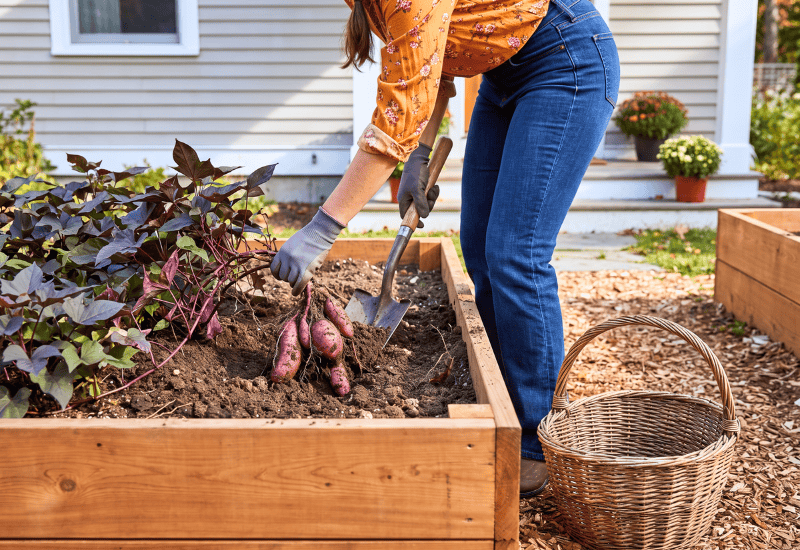
Most patio pots are treated the same way across much of the country in October. The frosted sweet potato vine is lifted by the drooping stems, dumped into the compost pile with its potting soil, and left there until May when you buy a new ‘Margarita’ or ‘Blackie’ chartreuse from your garden center.
The part that most of us miss when this happens is that which falls out of the pot along with the soil. Sweet potato vines are cultivars of the same plant we roast at Thanksgiving time, Ipomoea batatas. By autumn, many of them are growing roots that appear in the soil near the top and are purple, pink, or white in color. Each of them has captured all the nutrients and energy for next year, and they are capable of sending up new vines come spring.
The process doesn’t require a grow light or greenhouse. It requires a garden fork, about two weeks of warm weather, and some sort of a place to store these root plants. If you can get all of these things right, then one plant will give you free vines in next year’s pots. Getting them wrong, particularly the temperature part, will end up with you opening your box in January only to see them as mush. This is how it should be done.
The Purple “Potato” Hiding in Your Planter

In truth, that plant sold as an “annual” in spring is definitely not that. Ornamental sweet potato vine is a tropical perennial, but it is only sold as an annual, meaning that you can overwinter it easily. In warm conditions, it will continue to grow, and in the zone 9 of South Carolina, it can spend winter outside. In all colder areas, however, the plant is killed by frost, and only swollen roots in the ground can survive if dug out in time.
To speak botanically, those lumps cannot be called tubers. The proper term here is tuberous roots, as tuber is a swollen stem, while in this case the roots become swollen. Moreover, sweet potato and potatoes have very different botanical families – the sweet potato is not a relative to the potato at all. Yet we will use the term “tubers,” just as gardeners usually do.
There are many growers who have no clue about their presence. Thus, one forum gardener confessed that she grew many of those vines and did not pull any of them from the ground to see that they produce tubers. As such, she hopes that by keeping the tubers, she will avoid buying plants every year.
As for cooking with them, Clemson Extension confirms that tubers are edible, and NC State claims that the flavor is inferior as compared to ordinary potatoes. The cultivars are bred to have decorative foliage and not taste good.
1. Dig Now, Before the Cold Soil Kills Everything You Want

This time, speed beats accuracy, and your plant will give you all necessary signals. According to Purdue Extension, the roots continue growing even after the frosts kill the vines, so you don’t need any awards for September harvesting. But after this time period, everything changes very fast when the nights get cold. And when the soil gets cold enough – 50°F – the roots start developing chill injuries and then rot when kept for storage. If frost has already turned the leaves black, you shouldn’t hesitate waiting for sunny days anymore.
The option of leaving sweet potatoes in the ground doesn’t seem to be reasonable. A grower with more than 12 years of experience says that they would rot to mush in winter.
Be sure to begin digging far away from the stem, loosening the root mass with the help of garden fork and lifting, not prying. The skins of sweet potatoes are very thin, and bruised ones may rot easily. Try to brush the dirt from the roots instead of using water, just as suggested by Penn State.
But one thing should be admitted here: an Illinois Extension educator admits that the container vines rarely form tubers and those little ones dry out in storage. Large tubers are produced only on garden beds and big containers. Little ones should be considered as Plan B.
2. The Two-Week Warm Rest Most Gardeners Skip

Just dug out of the ground? Well, yes! But the truth is, their delicate skins make storage difficult! And, according to the specialists from Penn State Extension Service, the main cause of spoilage after harvest is damage due to cuts… Thus, the process called curing is absolutely essential for your crops, to prevent rotting and fungal growth, otherwise your tubers will simply rot before winter!
How much time is necessary? Well, there are professional recommendations on this point: Purdue University recommends curing for ten days, maintaining temperature at around 80-85° F and 85%-90% relative humidity. But how to achieve such conditions indoors?
Not that difficult at all, if you listen to Garden Gate’s advice: arrange your tubers on newspaper layers inside the kitchen where the temperature rises above the ambient one. For example, put them near a fridge or water heater, but do not neglect their hydration, as Mother Earth News states that sweet potatoes exposed to 50% humidity levels decayed twice faster compared to the others kept at 82%.
Finally, what is the right indication that curing is done? Simply rub two pieces against each other – their skin remains intact and smooth? Great news, because now they are ready for storage!
3. Your Garage Is Probably Too Cold for These

It can seem very hard to preserve sweet potato vines for use next year… Or rather it is quite simple, except when storing them… Many of us tend to store geraniums and dahlias in unheated spaces like garages… Which works well! Except, unlike them, sweet potatoes are tropical plants that cannot withstand cold temperatures in the way other plants can! According to UMass Extension recommendations, the best conditions include temperatures ranging between 55 and 60 degrees Fahrenheit, but lower than 50 degrees causes chilling injury. As a consequence, you may experience rotting and shortened storage period!
What is important about this condition is that sometimes it is not obvious when it happened at once! Mother Earth News explains that temperatures lower than 55 degrees result in hard-core injury that is difficult to identify visually until December!
Of course, too high temperature does not help either! Warm storage causes sprouting and dehydration! So what are proper storage conditions? Well, you will find them cool, such as basements corners, closet rooms against exterior walls or even heated garages as recommended by Garden Gate Magazine!
Packaging process is not complex: cured tubers need to be placed in open boxes covered with layers of dried sawdust or sphagnum moss! And remember: NEVER refrigerate your sweet potatoes, because Purdue University recommends avoiding that exact situation due to possible damage from chilling.
4. The Monthly Squeeze Test That Stops Rot Spreading

Of course, having successfully stored your sweet potatoes, it would be nice to simply leave them there without any thoughts or actions, till the springtime arrives! Well, yes, that’s how people usually behave… But your sweet potatoes will not agree! As a well-experienced grower puts it, these vegetables will decay very quickly if something gets wrong, because the rot spreads easily between individual tubers. Every month, uncover your storage container and feel them. According to the magazine Garden Gate, you should simply get rid of those potatoes which become soft or rotten.
Some wrinkling is usual. If the shriveling occurs deeply in the tubers, your location lacks enough moisture, and you should cover it with a bit moistened cloth.
Finally, sprouting is a sign of excessively high temperature levels. However, you do not need to worry about it, since according to Mother Earth News, sweet potato sprouts are perfectly edible unlike dangerous sprouts produced by regular potatoes.
Simply transfer your storage containers into a bit cooler place, and you’ll be good!
5. One Tuber, a Whole Tray of Plants by May

This is the real reward of saving those precious and precious roots… Every single one of them produces numerous sprouts, or “slips”, each developing into a completely independent individual…
Start working on it by late winter, so slips are ready before the last spring frost arrives. According to Garden Gate, bury three-quarters of the tuber underground, sharp end down, in a pot filled with moist sand, under fluorescent lamps on heating mats set to 75-80ºF. The sprouting process begins; once sprouts reach five inches in length, cut them from the main stem and transfer to individual pots with good quality soil, under fluorescent lights again, until all dangers from cold weather have gone away. Move outdoors afterwards.
But if you do not fancy all the fuss above, you can still succeed in planting your saved tubers – the Toronto Master Gardeners advise simply to place the entire root underground, right outdoors, after the last frost. Full sun and well-draining soils required! You will develop only one single plant in return, compared to dozens using the method above, but hey – it is free and easy gardening, after all!
Tiny Tubers or None? Snip the Vine and Bring It Inside

And while your pots might disappoint with their content, your vines certainly won’t perish… In other words, you can store cuttings in water overwinter, as recommended by Toronto Master Gardeners… Just choose one with several leaf nodes, remove the bottom leaves and put it in a glass jar filled with water… Roots will sprout in just several days! Your cutting can thrive indoors throughout the winter months, as long as you change its water each week to prevent bacterial growth.
But some gardeners prefer the simpler solution, and don’t bother with water jars… Instead, they simply transplant the cut-back vines directly indoors for overwintering! One such gardener works for Illinois Extension. In previous years, she had serious problems storing tubers in containers inside her basement, watching them shrivel away every year. Now, she overwinters her chartreuse and purple vines indoors, in front of sunny windows as houseplants… After carefully inspecting them for insects!
And that’s literally everything that’s needed: either jars of water or boxes with tubers in your basement or garage. With either method, your vines will survive the winter easily, to surprise you when spring arrives… You’ll know how to prepare them, and your neighbors won’t even get a chance!
