


There’s a reason so many gardeners fall for delphiniums the moment they see them in a catalog. Those towering spikes of blue look like something out of an English cottage garden — tall, elegant, impossible to ignore. You plant them, you wait a full year for that first bloom, and you picture exactly how good it’s going to look.
Then the deer find it first.
One morning you walk out to check on the buds, and the whole spike is gone. Not nibbled — gone. Just a bare stalk where a season’s worth of patience used to be. For an annual, that’s a bad week. For a biennial, it’s worse. You don’t get a do-over until next year, because the plant only blooms once, and the deer just took it.
If you’ve already read our guide on the best biennials to sow in June and July, you know how rewarding these two-year bloomers can be — delphiniums, foxglove, hollyhock, and more, all worth the wait. But that same guide also comes with a quiet catch: a few of those varieties are exactly the kind deer treat like a buffet. This list picks up where that one left off, focused entirely on the biennials deer won’t touch in the first place.
So the question worth asking isn’t “how do I stop deer” — you can’t, not really. It’s “what can I plant instead that they won’t bother touching in the first place?”
Turns out, quite a lot.
The biennials on this list aren’t the ones with a soft “deer generally dislike it” disclaimer buried in a plant catalog. They’re the ones deer skip on sight — thanks to fuzzy, felted leaves, sharp aromatic oils, or bitter sap that makes a single bite not worth the effort. And every one of them still delivers the drama you wanted from that delphinium: height, color, texture, the kind of bloom that makes a border look finished.
Below, we’ve split the list into two groups: true US natives first, followed by a handful of non-native varieties that have earned their place in American gardens through decades of reliable performance. Native or not, every plant here passed the same test — deer leave it alone.
Sow these now, and next spring, you get the payoff — without gambling a full year of growth on whether the deer agree with your taste.
1. Standing Cypress (Ipomopsis rubra)

Hummingbirds find this plant before you do. Tall, narrow spikes rise straight up out of a low rosette of fine, almost feathery foliage, and by early summer they’re lined top to bottom with tubular red-orange flowers that hummingbirds treat like a dedicated feeding station. That same delicate, ferny foliage that looks so soft is part of why deer tend to pass it over — there’s little substance to it, and what’s there carries a faint bitterness most browsers don’t bother with.
It thrives in poor, sandy, well-drained soil and actually performs worse in rich garden beds, making it a natural fit for a hot, dry, neglected spot where nothing else wants to grow. Once established, it self-seeds readily throughout the Southeast, often returning as a small colony rather than a single plant. Pair it with Black-Eyed Susan for a warm, complementary color echo, or Butterfly Weed to double down on the pollinator traffic.
Zones: 6–9
Native range: Southeastern US
Size: 3–5 feet tall, 1 foot wide
Light: Full sun
2. Biennial Gaura (Gaura biennis)

There’s a particular kind of movement in a garden that only wiry, airy plants can create, and Biennial Gaura is built entirely around it. Small pink-and-white flowers open along tall, branching stems that catch the slightest breeze, giving the whole plant a fluttering, butterfly-like quality that denser blooms can’t match. That same wiry stem structure — tough, thin, and unrewarding to chew through — is a large part of why deer generally leave it alone.
It handles average to poor soil without complaint and tolerates both drought and heat once its roots are established, asking very little in return for the movement it brings to a border. Left in place, it self-seeds modestly, filling in gaps the following year rather than spreading aggressively. Grow it alongside Little Bluestem for textural contrast, or Purple Coneflower for a native prairie-style pairing.
Zones: 4–8
Native range: Central and Eastern US
Size: 3–5 feet tall, 1–2 feet wide
Light: Full sun to part shade
3. Great Angelica (Angelica atropurpurea)

If Korean Angelica is the showy import, Great Angelica is its native answer — same architectural presence, same dramatic umbrella-shaped flower clusters, just grown from a plant that’s been part of Eastern wetlands and meadows long before any of us started gardening. Its stems run a deep, distinctive purple, holding up rounded clusters of small greenish-white flowers that pollinators swarm to in early summer. The strong, aromatic bitterness in its sap is the same defense mechanism found across the Angelica genus, and it’s enough to keep deer from bothering with it.
It wants consistently moist to wet soil — a streamside or low, damp corner of the yard suits it far better than an average dry border. Once settled, it tends to persist as a small colony through self-seeding, particularly in soil that stays reliably moist. Pair it with Joe Pye Weed for a matching wetland-native combination, or Cardinal Flower for a bold red contrast against its purple stems.
Zones: 3–7
Native range: Eastern and Central US
Size: 4–6 feet tall, 2–3 feet wide
Light: Full sun to part shade
4. Curlycup Gumweed (Grindelia squarrosa)

Touch this plant before it flowers and you’ll understand its whole strategy immediately — the buds are coated in a sticky, resinous gum that gives the plant its name, and that same resin runs through the foliage. It’s an unglamorous defense, but an effective one: once the bright yellow, daisy-like flowers open in mid-to-late summer, deer have already learned to avoid the plant on contact alone, well before they’d get anywhere near the bloom.
Curlycup Gumweed thrives in dry, poor, even compacted soil, and it’s often one of the last plants standing in a drought when everything else in the border has given up. It self-seeds reliably in disturbed or lean ground, spreading gradually rather than aggressively. Grow it with Blanket Flower for a matching warm-yellow palette, or Prairie Coneflower for a tough, drought-resistant native pairing.
Zones: 4–9
Native range: Western US, naturalized eastward
Size: 1–2 feet tall, 1–2 feet wide
Light: Full sun
5. Fringed Gentian (Gentianopsis crinita)

Most of the garden has already gone quiet by the time this one performs. While summer’s bloomers are winding down, Fringed Gentian saves its display for September and October, opening deep, iridescent blue flowers with delicately fringed petal edges — a color rarely seen this late in the season. Multiple native plant growers rate it highly deer-resistant, and it’s largely left alone by rabbits as well, making it one of the few true fall standouts that doesn’t need protection.
It needs consistently moist to wet soil and full sun to part sun, doing especially well at the edge of a rain garden or low, damp meadow planting. One important note for this one specifically: it’s considered a species of conservation concern in parts of its range (listed as potentially threatened in Ohio, for instance), so it should always be sourced as nursery-propagated seed or plants — never wild-collected. Pair it with Turtlehead for a matching wet-soil, native combination, or Joe Pye Weed for late-season height behind it.
Zones: 3–8
Native range: Eastern US and Eastern Canada
Size: 1–2 feet tall, 1 foot wide
Light: Full sun to part sun
6. Western Wallflower (Erysimum capitatum)

Brush past this plant on a warm afternoon and you’ll catch a sharp, peppery scent rising off the foliage — a telltale sign it belongs to the mustard family, the same group responsible for horseradish, mustard greens, and other plants deer have learned to avoid on principle. Clusters of bright orange to yellow flowers cover the top of each stem in mid-spring, giving an early, welcome burst of color before most biennials have even started their second-year growth. Worth noting honestly: while the pungent mustard-family compounds are a well-documented deer deterrent across the genus, direct deer-resistance data on this specific native species is thinner than on the other plants in this list — treat it as a strong probability rather than a guarantee.
It grows best in lean, well-drained, even rocky soil, reflecting its native habitat across dry western slopes and disturbed ground. It self-seeds readily under the right conditions, often naturalizing into loose drifts. Pair it with Penstemon for a classic western native combination, or Blue Flax for a soft blue-and-orange contrast.
Zones: 3–8
Native range: Western and Central US
Size: 1–2 feet tall, 1 foot wide
Light: Full sun
7. Evening Primrose (Oenothera biennis)

There’s a small daily event built into this plant that most gardens don’t have: its pale yellow, lemon-scented flowers wait until dusk to open, unfurling right as the moths and night-flying pollinators start their shift, then closing again by late morning. It’s a true US native, and its coarse, slightly hairy foliage carries a bitterness that keeps deer moving past it even under real browse pressure — this isn’t a plant with a soft “generally avoided” reputation, it’s one that consistently tests low on actual deer-damage surveys.
Give it average or even poor, well-drained soil and it will outperform anything grown in rich, coddled ground — this is a plant built for neglect, not fuss. It self-seeds generously once established, often turning a single planting into a self-sustaining patch within two seasons. Pair it with Black-Eyed Susan for overlapping bloom in warm yellow tones, or Butterfly Weed if you want a pollinator-focused planting that stays active from morning through dusk.
Zones: 3–9
Native range: North America
Size: 3–5 feet tall, 1–2 feet wide
Light: Full sun
8. Black-Eyed Susan (Rudbeckia hirta)
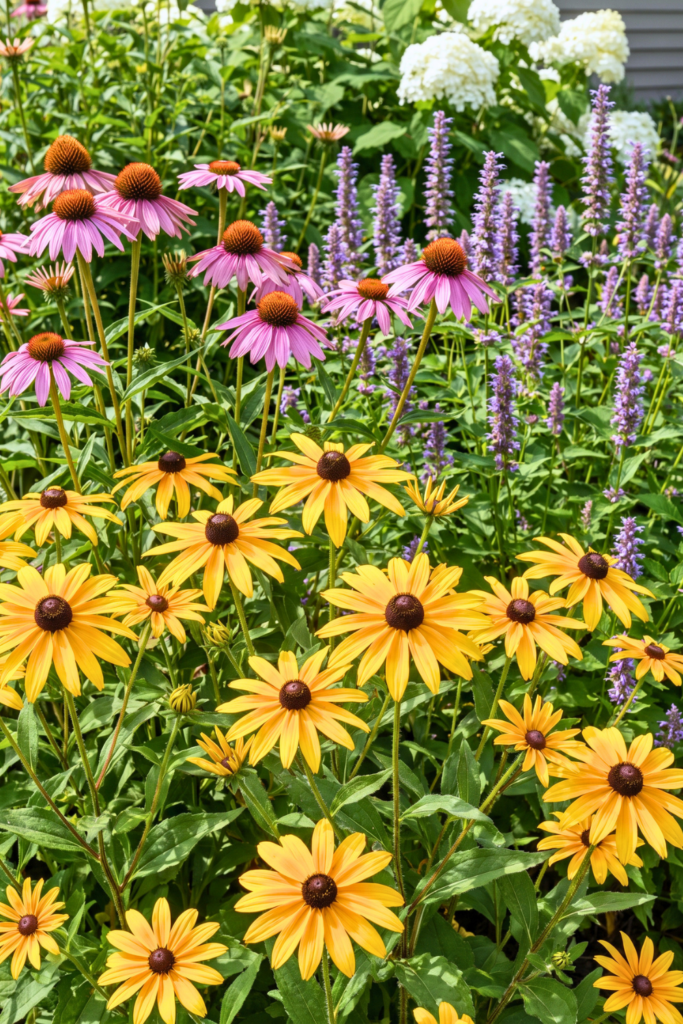
Golden-orange petals wrapped around a dark chocolate-brown center — this is the flower most people picture the moment someone says “wildflower meadow,” and it earns that reputation honestly. It blooms in sturdy, reliable waves all summer long, each flower held on a stiff stem above a low clump of foliage that’s rough and bristly to the touch. That texture is the whole story here: the hairy, coarse leaf surface is enough on its own to keep deer from bothering with it, even when nearby plants are getting hammered.
It’s about as low-maintenance as a native gets — average, well-drained soil, real tolerance for both drought and summer heat once it’s established, and almost no attention required beyond a sunny spot. In warmer zones it often behaves more like a short-lived perennial than a strict biennial, reseeding itself into a lasting patch you’ll rarely need to replant. For a classic native meadow look, grow it beside Purple Coneflower for contrasting color and shape, or Joe Pye Weed for late-summer height behind it.
Zones: 3–9
Native range: North America
Size: 1–3 feet tall, 1–2 feet wide
Light: Full sun to part shade
Beyond Native: More Deer-Resistant Biennials Worth Growing
The eight biennials above are all true US natives — but “native” isn’t the only path to a deer-proof border. The plants below aren’t native to North America, yet they’ve earned a permanent place in American gardens for good reason: they’re widely available through mainstream US nurseries and seed companies, they thrive across most US hardiness zones, and deer avoid them just as reliably as anything native. If you want even more variety and color options beyond the native list, these six round things out.
9. Korean Angelica (Angelica gigas)
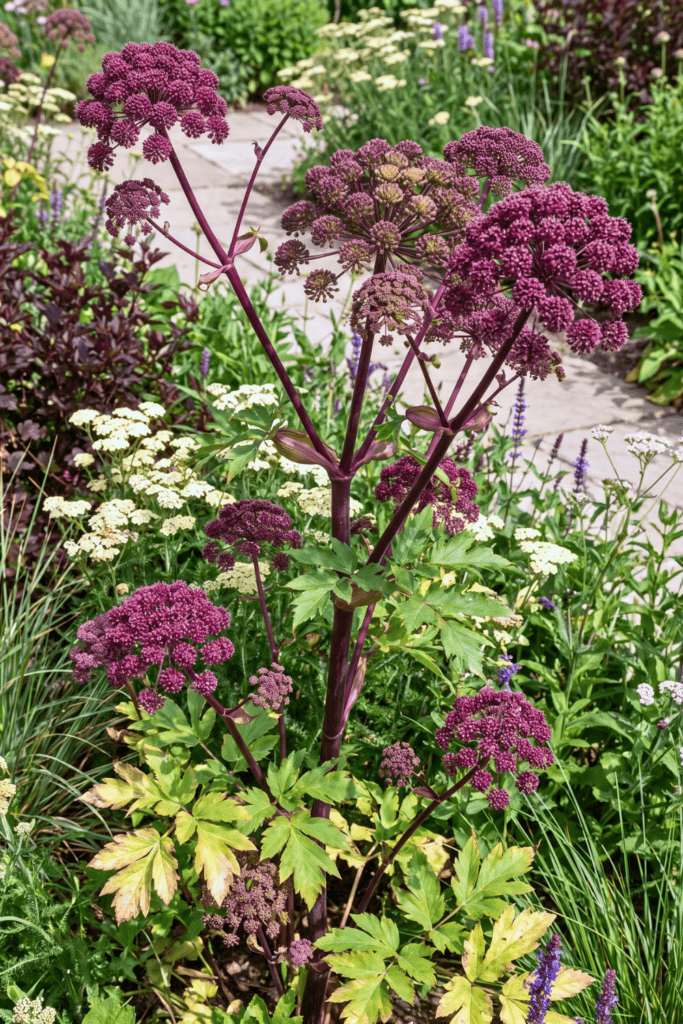
Most gardeners chasing that deep, wine-dark color in a border reach for dahlias — and then spend every fall digging up tubers before frost. Korean Angelica skips that whole chore. It rises on its own each year, and by late summer, branching stems carry umbrella-shaped clusters of flowers in a color so deep it reads almost black in low light, held above bold, celery-like foliage that smells sharply aromatic the moment it’s brushed. That scent is doing real work: the same volatile oils and bitter compounds in the sap that make the plant smell so distinctive are exactly what keep deer from ever taking a second bite.
Angelica thrives in rich, consistently moist soil, and it’s more shade-tolerant than most tall bloomers of its size, making it a rare option for a part-shade border that still wants height and drama. Once it’s settled in, it self-seeds modestly — not aggressively, just enough that you’re rarely starting over from a bare patch. For a companion planting that leans into the same moody palette, pair it with Astilbe for feathery texture at a lower level, or Ligularia for matching bold foliage that won’t compete for the spotlight.
Zones: 4–8
Origin: Korea, Japan, China
Size: 4–6 feet tall, 2–3 feet wide
Light: Full sun to part shade
10. Giant Silver Mullein (Verbascum bombyciferum)

Picture a plant dusted in frost in the middle of July — that’s the first impression Giant Silver Mullein leaves, before you’ve even noticed the flowers. Every leaf is coated in a dense, silvery-white felt, soft enough to look almost woven, and by its second year that same felted rosette sends up a single towering spike, five to six feet tall, studded with bright yellow blooms that open in slow succession up the stem rather than all at once. That wooly coating isn’t just for looks — it’s a genuine physical deterrent, coating the leaf surface with a texture deer find unpleasant to even attempt chewing through.
It performs best in poor, lean, well-drained soil, and counterintuitively does worse in rich garden beds — treat it like it wants neglect, not pampering. Left to its own devices, it self-seeds readily, so a dry, forgotten corner of the yard often becomes a permanent silver-and-gold feature without you doing anything at all. Grow it alongside Russian sage for a matching silver-blue palette, or Lamb’s Ear to double down on that soft, felted texture at ground level.
Zones: 4–8
Origin: Turkey
Size: 5–6 feet tall, 1–2 feet wide
Light: Full sun
11. Sea Holly / Miss Willmott’s Ghost (Eryngium giganteum)

There’s a story behind the nickname worth knowing: Victorian gardener Ellen Willmott was said to scatter its seeds in gardens she visited without asking — and once it flowered the following year, no one could quite figure out where it came from. Once you see it in bloom, the impulse makes sense. Metallic steel-blue flower cones sit nested inside spiny, silver-white bracts that catch light almost like frost crystals, and that same spininess is precisely why deer give the whole plant a wide berth — it’s an unpleasant, effortful bite for very little reward.
Lean, sharply drained soil is non-negotiable here; rich or damp ground causes far more problems than drought ever will, so treat it like you would a Mediterranean herb rather than a typical border perennial. Established plants self-seed reliably, often showing up the following year in gaps you didn’t plant at all. For a textural, silvery planting that thrives on the same benign neglect, pair it with ornamental grasses for movement, or Russian sage for a matching cool-toned palette.
Zones: 5–9
Origin: Caucasus region
Size: 2–3 feet tall, 1–2 feet wide
Light: Full sun
12. Rusty Foxglove (Digitalis ferruginea)

Every foxglove earns its deer resistance the same way — through toxic cardiac compounds built into every part of the plant — but Rusty Foxglove wears that toughness with a completely different look than its purple cousin. Tall spikes, often reaching five feet, carry dozens of small, tightly packed, tan-and-rust colored flowers with fine veining, giving the whole plant a warm, honeycomb-like texture rather than the bold, open blooms of common foxglove. Hummingbirds and pollinators treat the spike like a buffet line, working their way up one flower at a time.
It grows best in average, well-drained soil with consistent moisture, tolerating full sun to part shade without much complaint. Once established, it self-sows freely, often building into a naturalized colony within a few seasons. Since it’s toxic to humans and pets, gloves are worth wearing during any handling or deadheading. Pair it with Astilbe for textural contrast in a part-shade border, or Ligularia for a bold-and-tall combination that echoes its architectural height.
Zones: 4–9
Origin: Southeastern Europe, Turkey, Caucasus region
Size: 3–5 feet tall, 1–1.5 feet wide
Light: Full sun to part shade
